
BLOG ARCHIVE
Snowdonia in Autumn | On Location
A three-day autumn journey through Snowdonia, capturing intimate woodland scenes, grand vistas, and fresh perspectives on this iconic landscape.
Snowdonia in autumn has been on my to-do list for a few years now. I’ve visited in both the colder and warmer months, but never in between. As is always the case when trying to photograph seasonal change, timing is everything. Arrive too early, and the landscape still feels like late summer; too late and much of the colour has already faded. Added to that is the challenge of localised change, where higher ground may be showing autumnal tones while the valleys below remain stubbornly green.
That uncertainty is manageable if you live nearby and can return regularly to see how the season is progressing, but when you’re a good five-hour drive away, it becomes far more of a gamble. It’s also one of the reasons I often talk about the value of photographing locally, where being able to respond quickly to subtle changes in light, weather, and season can make a real difference to the work you produce.
In the end, I settled on a mid-October weekend, booked a hotel with easy access to several areas I wanted to explore, and set off cross-country for a three-day landscape photography trip to Snowdonia.
Fujifilm XT5 | XF16-55mm | 55mm | 1/10th Second | f/11 | ISO125
Fujifilm XT5 | XF16-55mm | 41mm | 1/25th Second | f/11 | ISO400
My first stop after arriving was to revisit the view of Llyn Gwynant. It’s a spot I’ve photographed a few times before, and while it requires a little more effort than the classic roadside viewpoints most people settle for, I think the extra hike is well worth it. On previous visits, I’d never been lucky enough to have favourable light, but this time, after a quick assessment of the conditions — including the sun’s position in the sky — I could see the potential, and I decided to make the short climb to the viewpoint.
One of my goals on this trip was to capture a mix of woodland scenes, intimate landscapes, and the grand vistas Snowdonia is famous for. Achieving that balance can be tricky, as it requires staying alert to opportunities even while making your way to a specific viewpoint. To give myself the best chance, I made a point of spending plenty of time at each location, slowing down, observing the environment, and letting the photos reveal themselves.
To reach the open ground above the hill, I passed through a small woodland filled with characterful trees, just starting to show the early signs of autumn. By taking my time and keeping my eyes open rather than marching head down, I was able to spot and compose the two woodland images shared above.
A small note for readers: for the best experience of these images, I recommend viewing this blog on a larger screen, as each photo can be selected to display a larger version, which doesn’t work quite as well on mobile devices.
DJI Mini 3 Pro | 24mm (effective) | 1/2500th Second | f/1.7 | ISO100
Fujifilm XT5 | XF16-55mm | 20mm | 1/60th Second | f/11 | ISO125
Fujifilm XT5 | XF16-55mm | 29mm | 1/60th Second | f/11 | ISO125
Reaching the viewpoint high above the tree line, I found a spot with uninterrupted views of Llyn Gwynant and the majestic mountains beyond. By this time, it was just after midday, and although the sun had climbed as high as it would go, the October light still fell at a gentle angle—not as low as in winter, but enough to cast soft, dappled patterns across the landscape.
I spent some time capturing images with my main camera on its tripod, and in between shots, launched the drone to gain a higher perspective and manoeuvre around the scene. This vantage point allowed me to use the trees as the main focal point, with the lake and surrounding valley forming a dramatic, almost cinematic backdrop—arguably my favourite shot from this location.
DJI Mini 3 Pro | 24mm (effective) | 1/8000th Second | f/1.7 | ISO100
After packing away the drone, I made my way back to the car, ready for the short drive over to the Ogwen Valley and keen to see what new compositions awaited me there.
Typically, when photographing in this area, I’ll hike up the north side of the valley along Afon Lloer to capture the classic view of Tryfan beside the cascades. This time, however, I wanted to explore a slightly different angle. The Ogwen Valley is such a popular spot for landscape photography in Snowdonia that truly unique compositions of the grand vistas are hard to come by. Still, I hoped that by climbing higher and keeping an open mind, I might uncover a fresh perspective—a more personal view of these familiar mountains. With that, I set off to see what the landscape would reveal.
Fujifilm XT5 | XF16-55mm | 16mm | 1/640th Second | f/10 | ISO125
It was getting on for late afternoon, and although the sunlight was still strong, I hadn’t seen anything worth photographing yet. I continued climbing the side of Pen Yr Ole Wen, thinking (or hoping) that the higher I got, the more chance I’d have of finding a good composition, and by then, the harsh light might have softened just a little more.
As I neared the top, the way the stone face of the mountain cut diagonally in front of Tryfan caught my attention. The light was softer now and still just enough to highlight the foreground. I wasn’t sure about the clouds on Tryfan’s peak as they were partly hiding the summit, but knowing how quickly conditions can change in Snowdonia, I set up the camera and took my first shot from this spot.
DJI Mini 3 Pro | 24mm (effective) | 1/8000th Second | f/1.7 | ISO100
I waited at this viewpoint for a while, hoping the light would continue to change. Eventually, the cloud atop Tryfan cleared just long enough for my vertical composition of the same scene, but before long, the cloud rolled back in and the light faded almost completely.
Before it disappeared entirely, I launched the drone. From a higher vantage point, away from Pen Yr Ole Wen, I was able to capture some central compositions of Tryfan, with Llyn Ogwen and the A5 snaking along the valley floor below.
DJI Mini 3 Pro | 24mm (effective) | 1/8000th Second | f/1.7 | ISO100
Fujifilm XT5 | XF16-55mm | 18mm | 1/320th Second | f/11 | ISO125
As the cloud rolled in and the light faded, I began my descent. I considered trying the classic composition of the waterfall with Tryfan, but the valley was now shrouded in low cloud, obscuring the mountain tops. Instead, staying true to my goal of capturing more intimate and unique scenes, I focused on a few compositions of Afon Lloer as it tumbled down the hillside. The ambient light had cooled considerably, giving the photos a softer, more neutral tone. These two square compositions are my favourites from the shots I captured on the way back down to the car.
Fujifilm XT5 | XF10-24mm | 10mm | 0.6 Seconds | f/9 | ISO125
Fujifilm XT5 | XF10-24mm | 14mm | 0.8 Seconds | f/14 | ISO125
The next day, I returned to the Gwynant Valley, this time exploring further along at Llyn Dinas. There were a few spots near the lake I wanted to revisit in the hope of capturing some autumnal tones—though I think it’s fair to say I had mixed success.
My first stop on the morning hike was to revisit the lone tree by the water. It’s a subject I always enjoy photographing here, full of character and, when the conditions are right, framed beautifully by the surrounding mountains.
Once again, I wasn’t blessed with dramatic light, and overall, the conditions were rather flat. Yet the tree’s shape and form are strong enough that it still stands out against an otherwise plain sky. Clutching at straws? Perhaps. But even if I was a little early for autumn colour, I genuinely like this photo.
In my view, getting a low vantage point is essential. It ensures that the lowest branch on the right of the trunk doesn’t overlap the horizon, while also incorporating the shrubbery across the forest floor, which adds texture and depth to the foreground.
Fujifilm XT5 | XF10-24mm | 11mm | 1/20th Second | f/8 | ISO125
Not far from the lake is a stone cottage I had discovered on a previous visit, and remember wondering back then how it might look in autumn. Being close by once again, I made a point of hiking to the spot to see for myself.
When I arrived, the light remained flat, and low cloud smothered the distant peaks. Thankfully, the landscape still offered plenty of warm, autumnal tones, so all was not lost. I set up my camera to frame the cottage at an angle, nestled into the hillside while still maintaining the valley views behind, and once satisfied with the composition, I captured the image below.
For transparency's sake, I should note that the cottage is regularly occupied and features a large solar panel on the roof. While this is great for the residents, it didn’t suit the tone I wanted to create, so—as I had done on a previous visit—I removed the panel in post-processing.
Before continuing my hike, I switched to my telephoto lens and focused on a smaller section of the landscape, highlighting some trees on the hillside adorned with subtle autumnal colour.
Fujifilm XT5 | XF16-55mm | 34mm | 1/6th Second | f/10 | ISO125
Fujifilm XT5 | XF70-300mm | 114mm | 1/4th Second | f/10 | ISO125
Making my way back down from the higher, open ground, I passed through a small woodland. After experimenting with a few compositions that didn’t quite work, I stumbled across the ruins of an old stone building, hidden among the trees. The structure was heavily overgrown and brimming with character, so I spent a few minutes exploring slightly elevated ground to find the best perspective.
This shot was as much about what I left out as what I included. The area was busy, full of textures and features, and I wanted to ensure the stone building remained the focal point without being lost in the woodland. Once I found the ideal spot, I carefully composed the image, keeping enough of the surrounding environment to convey the building’s setting, while trying to avoid unnecessary clutter.
Fujifilm XT5 | XF16-55mm | 27mm | 1/4th Second | f/10 | ISO125
By now, it was around 11 am, and as I walked back alongside Llyn Dinas, the wind had dropped, allowing reflections to form on the calm surface of the lake. Passing the lone tree I’d photographed earlier that morning, I noticed how it seemed to hover gracefully over the water. The smooth, reflective surface provided a clean background, making the tree really stand out in the frame.
I can’t claim this composition has never been photographed before, but it was new to me. Once again, slowing down and taking the time to observe the environment paid off, resulting in what may well be my favourite image from the trip—a subtle reminder of why patience and attention to detail are so important when photographing the landscapes of Snowdonia.
Fujifilm XT5 | XF70-300mm | 102mm | 1/3rd Second | f/13 | ISO125
Finishing up in the Gwynant Valley and before heading back over to the Ogwen Valley later that afternoon, I paid a relatively quick visit to Conwy Falls. It’s not a place I’d visited before, and being a sucker for a good waterfall, I made my way back through Betws-y-Coed to the car park at the Conwy Falls Cafe.
At this point, you might notice a distinct lack of waterfall photos here—and there’s a reason for that. Despite the falls being truly impressive, I struggled to find a composition that worked, so I took a step back, found a comfortable spot with my coffee, and simply enjoyed the view.
It wasn’t a total loss, though. While walking along the short path between the café and the falls, I spotted a couple of trees showing early autumn colour and managed to capture a few woodland shots I’m pleased with.
Even without the perfect waterfall images, I still highly recommend visiting Conwy Falls. They are easily accessible and make for an impressive spectacle, whether you’re photographing or just taking it all in.
Finishing my coffee by the falls and after a quick pit stop in Betws-y-Coed, I drove along the A5 to continue my day in the Ogwen Valley.
Fujifilm XT5 | XF16-55mm | 38mm | 1/5th Second | f/10 | ISO125
Fujifilm XT5 | XF16-55mm | 44mm | 1/13th Second | f/10 | ISO200
By now, it was getting close to mid-afternoon, and I had considered hiking the Glyderau Circular—much like on my previous trip. But, as time was getting on, I decided it was a bit too late to complete the full hike before dark without rushing my photography along the way, which, at the very least, would have made the experience stressful. Instead, I opted to hike up towards Y Garn, aiming to capture the valley from an elevated perspective.
As I set off from the car park, passing Llyn Idwal and climbing towards Y Garn, the weather was pleasant with a few broken clouds. But gradually, the clouds thickened, and before long I found myself walking in complete clag, with visibility reduced to barely ten metres.
I pressed on, hoping the cloud might clear and reveal the views again. And while it didn’t—at least initially—I was actually pleased. Higher up, the sky began to brighten, and within a few minutes, I broke through the cloud, greeted by one of the most incredible scenes I’ve ever witnessed.
Beneath me stretched a vast carpet of cloud, a vast cloud inversion, with only the tallest mountain peaks piercing through. For several minutes, I simply stood there, taking it all in, knowing I might never see such a sight again.
Eventually, I returned to photography mode, setting up my camera to capture the peaks that emerged above the clouds.
The photo here shows the view looking back down Y Garn towards the Ogwen Valley, highlighting the route I took up the mountain and the spot where I broke through the cloud. In the distance, the tips of Pen Yr Ole Wen and Carnedd Dafydd rise from the Carneddau range. I used the path along the ridge to lead the eye down towards the clouds below and the distant peaks—subtle, but hopefully effective.
Fujifilm XT5 | XF10-24mm | 17mm | 1/50th Second | f/11 | ISO125
Alongside taking photos with my main camera, I also sent the drone up to take in the view from an even higher vantage point and managed to take a couple of photos while doing so. My favourite is the one shown below, as the sun is behind the drone, illuminating the scene in front of the camera. It’s amazing to think there is an entire world underneath that thick layer of cloud, all probably existing in dark and gloomy conditions, and oblivious to the spectacular views being observed by people like me above the clouds.
also turned the drone towards the Snowdon range to the south, but the harsh sunlight created too much contrast, and the drone struggled to capture it cleanly, so I chose not to keep any of those shots.
DJI Mini 3 Pro | 24mm (effective) | 1/2000th Second | f/1.7 | ISO100
Fujifilm XT5 | XF16-55mm | 45mm | 1/50th Second | f/9 | ISO125
Fujifilm XT5 | XF16-55mm | 55mm | 1/125th Second | f/10 | ISO125
Fujifilm XT5 | XF16-55mm | 34mm | 1/80th Second | f/9 | ISO125
DJI Mini 3 Pro | 24mm (effective) | 1/2000th Second | f/1.7 | ISO100
Fujifilm XT5 | XF16-55mm | 47mm | 1/50th Second | f/10 | ISO125
After a truly memorable 90 minutes near the top of Y Garn, having experienced the best of the conditions up there, I packed my camera away and began the descent back towards Llyn Idwal. By now, the cloud had thickened considerably, and conditions down in the valley were gloomy. Even without dramatic light, I knew there was still the opportunity to create a few photos beside the lake, using the low cloud and cool tones to add atmosphere and mood.
For the shot below, I focused on making the large rocks a prominent foreground element, with the stone wall subtly leading the eye towards the mountainous walls of Cwm Idwal, forming a striking backdrop. I used an exposure of 0.8 seconds to introduce just a touch of movement in the flowing water, simplifying the areas between the rocks and helping them stand out. Overall, I’m really pleased with how this image turned out.
Fujifilm XT5 | XF10-24mm | 10mm | 0.8 Seconds | f/11 | ISO125
On the way back from climbing Y Garn, and before taking the previous photo, I had spotted this collection of partly submerged stones in the water. They seemed to line up, potentially usable as foreground interest, helping to lead the eye out, towards the imposing mountain range across the lake.
I used my circular polarising filter (CPL) to take some of the glare off the rocks, revealing some of the textures under the water, and with the winds calm, there were some nice reflections of the mountains on the lake’s surface. It all seemed to come together for me in that moment. Given how many people visit this lake, I’m certain I’m not the only one to photograph this composition, but it was genuinely new to me, so I’m pleased to have spotted it.
The last stop of the day was close to the car park, where I paused briefly to photograph this section of Afon Idwal as it tumbled down the hill towards me. I know this is a well-photographed cascade, but it’s such an accessible and easy photo to take that I will typically take a photo whenever I pass.
Without the low cloud, this composition can offer slightly better views of the Glyderau in the background, but unfortunately not today; however, with some nice contrast between the dark rock and white water and with a little tweaking of the shutter speed to achieve this look in the water, I still walked away with a photo I like.
Fujifilm XT5 | XF10-24mm | 10mm | 1/6th Second | f/10 | ISO125
Fujifilm XT5 | XF10-24mm | 10mm | 0.8 Seconds | f/11 | ISO125
Fujifilm XT5 | XF10-24mm | 13mm | 0.6 Seconds | f/8 | ISO400
For the first stop on my third and final day in North Wales, I visited Ffos Anoddun—better known to most as Fairy Glen, near Betws-y-Coed. The Welsh name, Ffos Anoddun, translates as “Deep Ditch,” though the location is far more enchanting than the name suggests. Fairy Glen (as I’ll call it from here on) is a narrow, tree-lined ravine, with the River Conwy flowing gracefully through it. I first visited this spot in late summer 2024 and had always planned to return, hoping to capture it adorned with autumnal colour.
You can see the original, summertime version I took in a previous post here, and I liked that composition, so I tried to recreate it. For a place like this, that might sound easy. But for some reason, I struggled to find the spot I took the photo from, but after a little trial and error, I got there and had my composition lined up.
As with a few other locations on this trip, the autumn colour hadn’t fully arrived, though there were subtle hints of the seasonal transition along the edges of the ravine. Not quite what I had hoped for, but enough to work with.
The long exposure works particularly well in this spot, as the foam created by the water cascading over the rocks forms interesting lines and textures as it travels downstream. Once in position, I mounted my Kase neutral density filter (10 or 6-stop—I can’t remember exactly) and began capturing the scene.
In the final versions shared further below, I also included a shorter exposure. While I slightly prefer the creative effect of the long exposure, the quicker shutter speed produces a more realistic view, and both work well. Photography is subjective, after all—and that’s exactly how it should be.
Fujifilm XT5 | XF50-140mm | 50mm | 8 Seconds | f/10 | ISO125
Having captured the composition I was after, I also experimented with a few different focal lengths. I’m particularly pleased with the result in the square crop below, where I went a little wider and arranged the river to flow diagonally through the frame, exiting towards the bottom right-hand corner. It’s a different take on this popular scene, and I’m quite pleased with the photo.
Fujifilm XT5 | XF16-55mm | 30mm | 8 Seconds | f/9 | ISO125
Fujifilm XT5 | XF50-140mm | 50mm | 60 Seconds | f/11 | ISO125
Fujifilm XT5 | XF50-140mm | 50mm | 1/10th Second | f/6.4 | ISO400
Fujifilm XT5 | XF16-55mm | 43mm | 1/3rd Second | f/16 | ISO125
Taking the slightly longer route along the river back to the car, I spotted this scene, which was interesting with the large rock, fallen tree and splash of seasonal colour in the trees.
I experimented with a few different focal lengths, taking in the wider scene as well as zooming in and isolating those autumnal colours with a closer crop. These were not necessarily up there with my favourite photos of the trip, but I still like them enough to share with you here.
My final stop of the day was at the Dinorwig Slate Quarry near Llanberis. I had planned to wander down to the Barics Dre Newydd (Anglesey Barracks), take a few photos there, and then explore the quarry before heading back to the car for the long drive home. However, the weather had other ideas.
The cloud cover that had been providing some soft, diffused light earlier quickly cleared after I arrived, leaving a bright, clear sky and harsh contrast—conditions that are far from ideal for the kind of photography I enjoy.
Fujifilm XT5 | XF50-140mm | 102mm | 1/6th Second | f/9 | ISO125
Before the cloud completely cleared, there were still occasional patches passing by, softening the light for brief moments. Wandering down the track towards the barracks, I noticed the trees showing much more autumnal colour than earlier, and I managed to stop and compose a couple of intimate woodland photos.
Once the sun broke through, I spent an hour or so exploring the quarry. It’s such an incredible place to roam, rich with history, and I thoroughly enjoyed my time there. Unfortunately, with the weather no longer cooperating, I didn’t take any more photos.
Fujifilm XT5 | XF16-55mm | 55mm | 0.4 Seconds | f/11 | ISO125
Fujifilm XT5 | XF16-55mm | 41mm | 1/4th Second | f/11 | ISO125
Overall, this was another successful trip, and I had an amazing time in such a stunningly epic landscape. Of course, things could have been better—more autumn colour on the trees, kinder light at Dinorwig Quarry, or improved conditions when photographing Tryfan on the first evening—but it would be unrealistic to expect everything to go perfectly. Let’s be honest, it could have been far worse; I could have battled strong winds and sideways rain, so I’m grateful for the conditions I did have.
As I mentioned at the start of this article, alongside revisiting some of my favourite spots in Snowdonia, my goal was to capture a mix of woodland, intimate landscapes, and wide vistas. To achieve this, I needed to slow down and give myself time to really observe the landscape and let the compositions reveal themselves. By doing so, I discovered some new, fresh perspectives and captured images I might have otherwise missed if I had been rushing around.
Thanks, as always, for sticking with these longer-form on-location articles. If you have any comments or questions, please feel free to leave them below.
Until next time,
Trevor
If you’ve enjoyed following this Snowdonia trip, you’ll find plenty more inspiration on my blog, where I share tips, insights, and photographs from across the region. From woodland scenes and intimate compositions to sweeping mountain vistas, it’s a celebration of the beauty and variety of landscape photography in Snowdonia.

Summertime Waterfall Photography in the Brecon Beacons
Join me for a 2 day summertime trip to photograph the waterfalls in the beautiful Brecon Beacons National Park
To date, I’ve made quite a few trips to photograph the waterfalls in the Brecon Beacons, and I’ve typically chosen to visit this area of Wales during spring and autumn to take advantage of the vibrant greens or autumnal colours provided by the woodlands at those times. This year, to mix things up a bit, I decided to schedule a visit towards the end of summer. Unlike many landscape photographers, I actually enjoy photographing the summer woodland and relish the challenge of seeking interesting images in a relatively difficult environment. With the fuller foliage helping to keep the bright skies out of my compositions, I set off on the 3–4 hour drive to the Brecon Beacons National Park in South Wales.
It’s worth noting that this summer has been quite a dry one, so I was expecting a light flow of water along the Afon Hepste—and as you can see from the photo of me standing in front of the upper section of Sgwd Isaf Clun-Gwyn, this was indeed the case. Typically, where I’m standing has gushing water falling over it, but with it being so dry I was able to climb down and stand in a spot that’s not often reachable.

Fujifilm XT5 | XF10-24mm | 10mm | 1/6th Second | f/10 | ISO125
Photographing the details
The day I arrived, there was very little cloud and plenty of high-contrast sunlight filtering into the valley, which made it difficult for me to take the style of photo I prefer. So, instead of fighting those specular highlights in the scene, I mounted the telephoto lens and spent the first part of the day zooming in on the falls and photographing smaller, more intimate compositions.

Fujifilm XT5 | XF50-140mm | 111mm | 0.6 Seconds | f/11 | ISO125

Fujifilm XT5 | XF50-140mm | 111mm | 0.6 Seconds | f/11 | ISO125
I spent a fun couple of hours with the telephoto lens, experimenting with different shutter speeds to create various effects in the water. The longer the shutter speed, the silkier the water became, and you can see the different settings I used directly beneath each photo in this article.

Fujifilm XT5 | XF50-140mm | 111mm | 0.6 Seconds | f/14 | ISO125
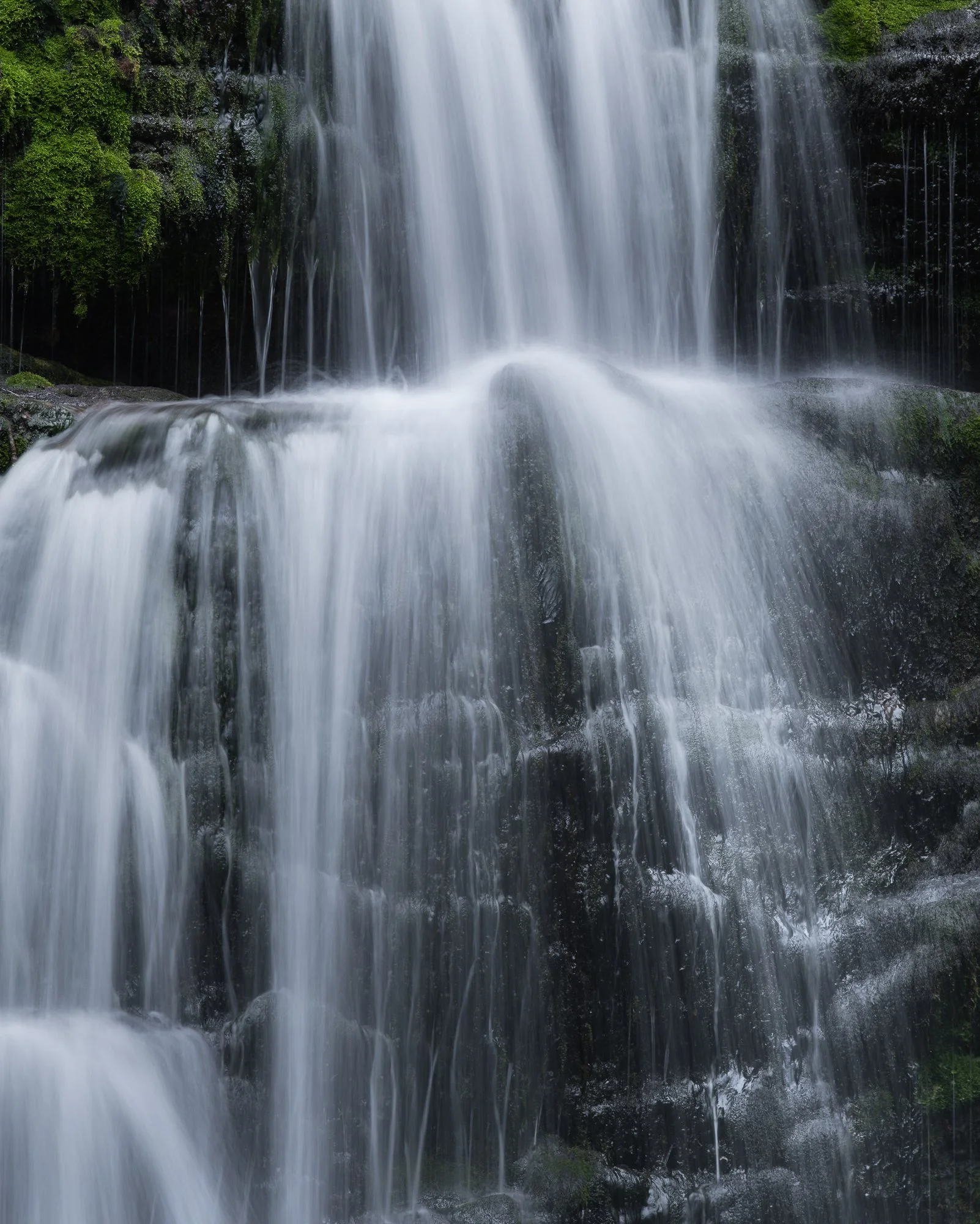
Fujifilm XT5 | XF50-140mm | 140mm | 1/2 Second | f/9 | ISO125

Fujifilm XT5 | XF50-140mm | 111mm | 1 Second | f/14 | ISO125

Fujifilm XT5 | XF50-140mm | 140mm | 1/2 Second | f/9 | ISO125
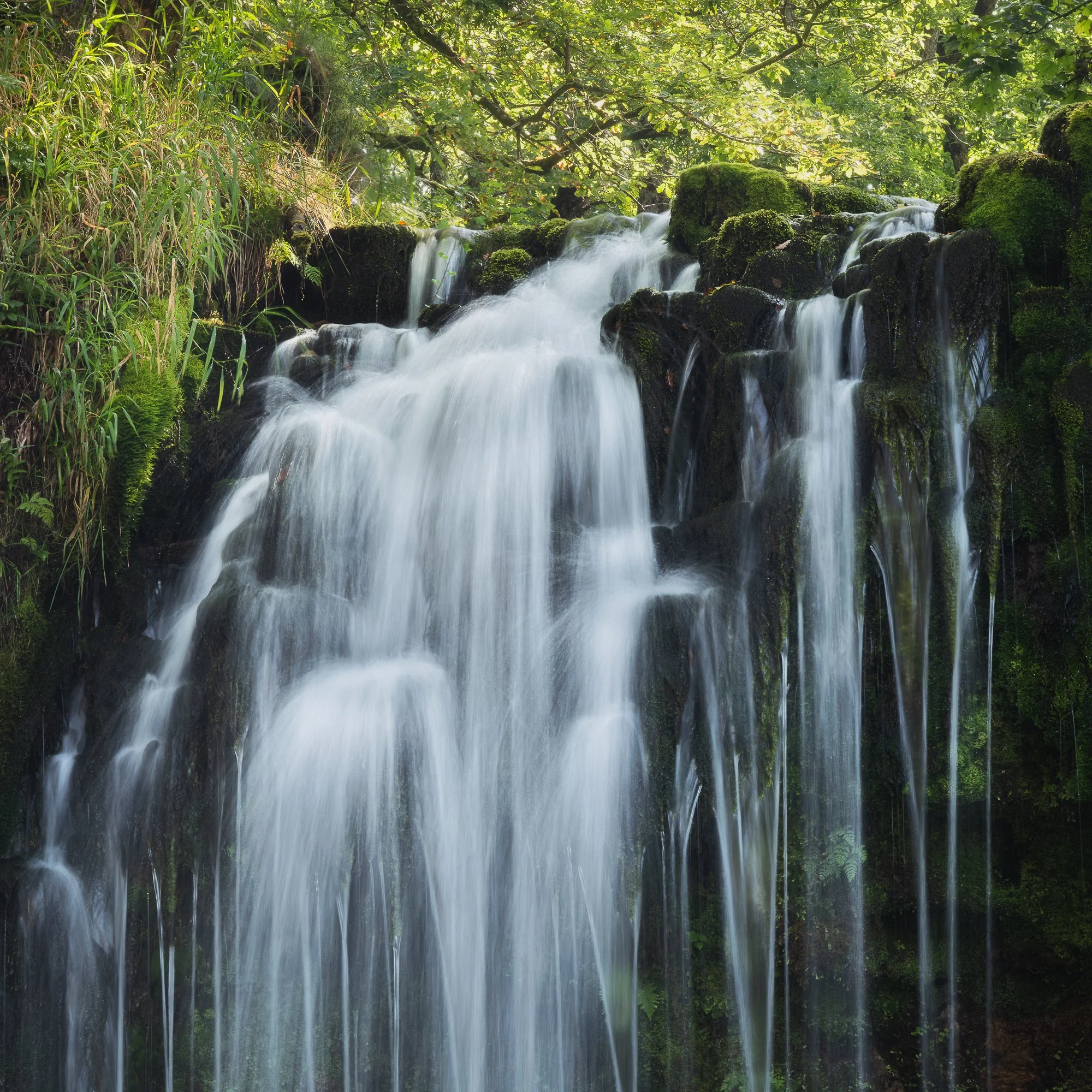
Fujifilm XT5 | XF50-140mm | 124mm | 1/3rd Second | f/11 | ISO125
Photographing Sgwd y Pannwr
When the cloud cover finally increased, it became easier to use a wider focal length and capture the entire waterfall in one frame without contending with harsh light on the landscape. At Sgwd y Pannwr, I climbed down to the plunge pool beneath the main falls to see if I could find something to use as foreground interest. After a few minutes of hunting around and testing different compositions, I settled on a couple of options—using either the rocks on the edge of the water or the green ferns further back. Both of these are posted below.

Fujifilm XT5 | XF10-24mm | 14mm | 1/6th Second | f/14 | ISO125

Fujifilm XT5 | XF50-140mm | 52mm | 1/2 Second | f/9 | ISO125

Fujifilm XT5 | XF10-24mm | 10mm | 1/3rd Second | f/11 | ISO125

Fujifilm XT5 | XF50-140mm | 140mm | 1/2 Second | f/9 | ISO125
Photographing Sgwd Isaf Clun-Gwyn
During the two-day trip, I spent a little time at Sgwd Isaf Clun-Gwyn, my favourite of all the falls along the Four Falls Trail. This waterfall is made up of multiple drops, offering many different photographic opportunities, but what I really like is how, beyond the obvious compositions, it challenges you to work harder to find interesting shots.
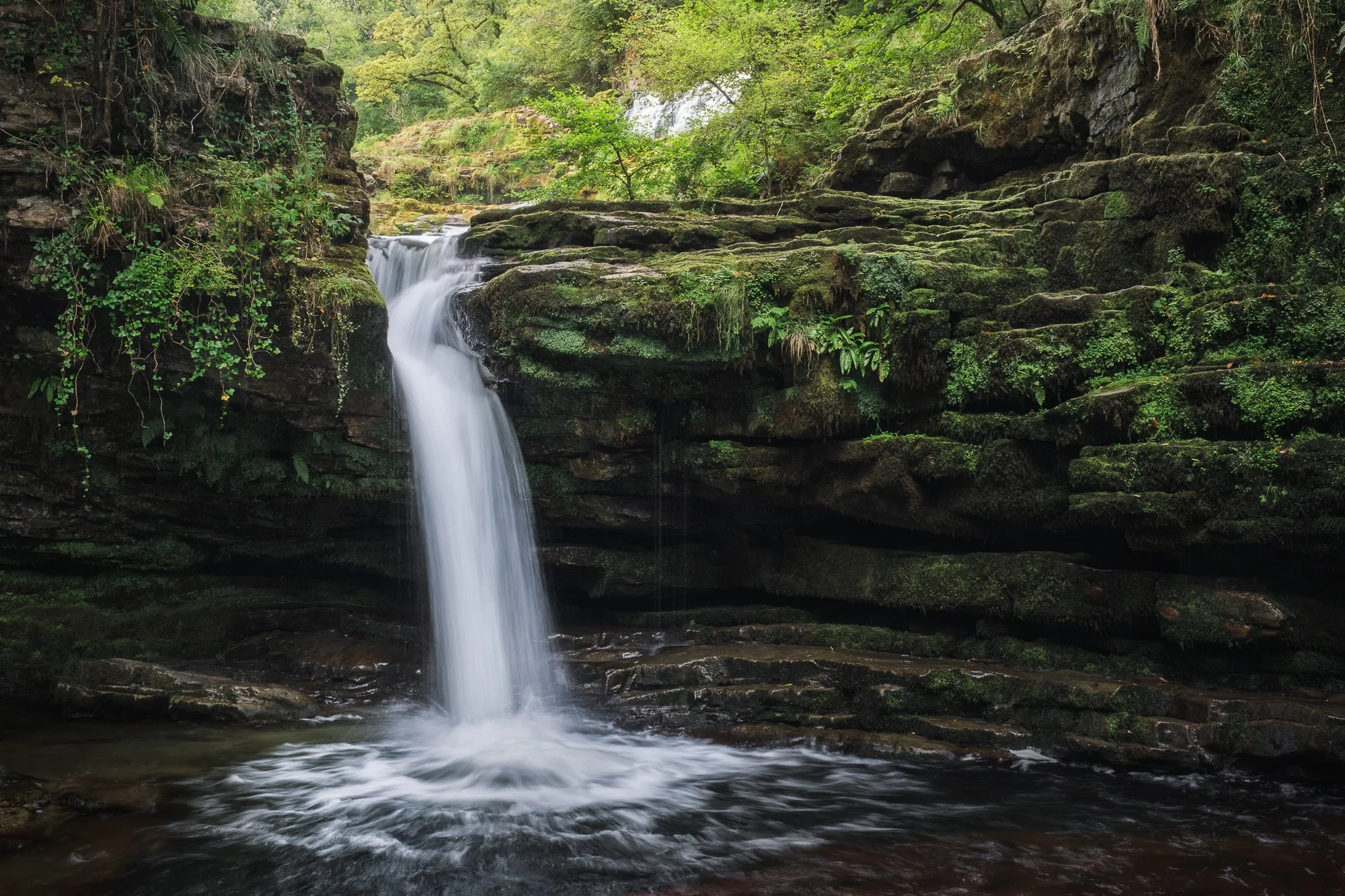
Fujifilm XT5 | XF16-55mm | 25mm | 1/4th Second | f/11 | ISO125

Fujifilm XT5 | XF10-24mm | 17mm | 1/4th Second | f/7.1 | ISO125

Fujifilm XT5 | XF10-24mm | 17mm | 1/6th Second | f/6.4 | ISO125
I’ve mentioned in previous blog posts that this view of Sgwd Isaf Clun-Gwyn is by far my favourite. Reaching it isn’t easy, and I mean that literally—this waterfall really makes you work for your shots. There are a couple of ways to get here: one involves scrambling down an almost vertical rock face (not for the faint-hearted), while the other is an easier stroll along the edge of the river—but only when water levels are low enough. Once you arrive, the effort feels worth it: the trees naturally frame the falls, highlighting the cascading water as it tumbles down the rocks into the plunge pool below.

Fujifilm XT5 | XF10-24mm | 11mm | 1/3rd Second | f/8 | ISO125
Photographing Sgwd Einion Gam
During previous visits to the Brecon Beacons, I’ve hiked along the Elidir Trail a couple of times, but I’ve never managed to reach Sgwd Einion Gam. It’s nicely tucked away upstream from Sgwd Gwladys, but to get there, you need to cross the river a couple of times—and on previous visits, the water levels have been too high.
As I wandered along the Elidir Trail this time, I could see that the water levels were far too low to make interesting waterfall photos, so I decided to hike up the river to Sgwd Einion Gam and use the opportunity to familiarise myself with the route for a future visit when conditions might be a little better.

Fujifilm XT5 | XF16-55mm | 26mm | 40 Seconds | f/9 | ISO125
As I suspected, the waterfall itself was underwhelming due to the lack of water, but it was still an impressive space to experience. Even though I wasn’t expecting much, I managed to capture a couple of long-exposure photos, making the most of the time I had there.
The image below is the result of being drawn to how the reflective light was falling on the rockface, making it appear almost metallic to the eye. With the help of an ND filter, I made a long exposure, smoothing out the water, leaving just a few trails of fallen leaves and enabling the texture of the rocks to stand out in the composition.
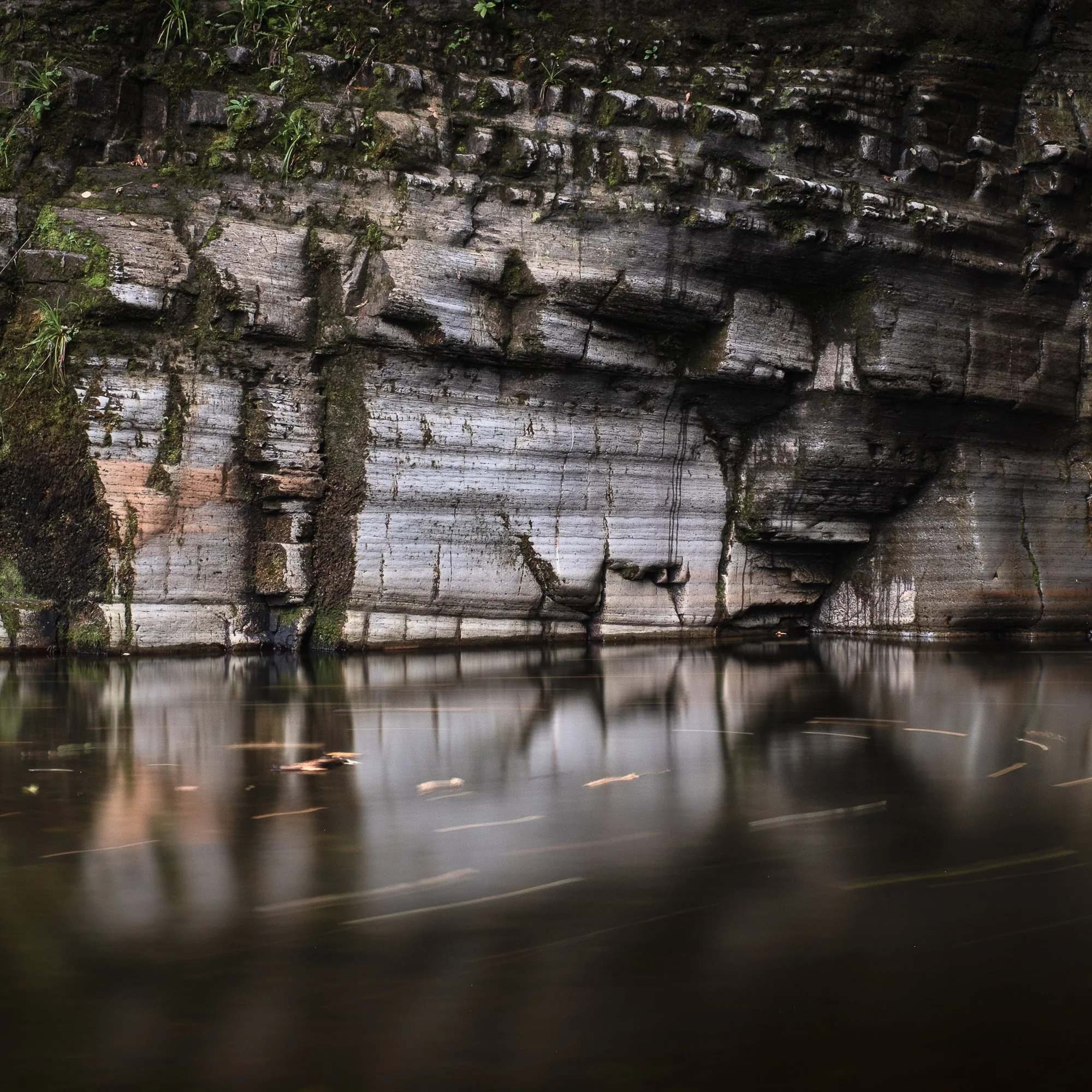
Fujifilm XT5 | XF16-55mm | 39mm | 25 Seconds | f/9 | ISO125
Photographing Sgwd Yr Eira
No trip to the Four Falls trail would be complete without photographing the famous Sgwd Yr Eira waterfall. Due to its popularity along the trail, I always make a point to arrive early in the morning, as that’s the only time you can take photos free of other people, so the next morning, I woke up and headed straight here.
Having spent some time here the day before photographing the details with my telephoto lens, I wanted to take a few wider compositions to feature the summer foliage, and by getting my camera lower to the ground, I could use the rocks and small cascades to add some foreground interest.

Fujifilm XT5 | XF10-24mm | 17mm | 0.6 Seconds | f/13 | ISO125

Fujifilm XT5 | XF10-24mm | 10mm | 1/4th Second | f/6.4 | ISO125
Shortly after taking the photos of Sgwd Yr Eira above, I noticed an impressive fern on the other side of the water. I stopped what I was doing, mounted my telephoto lens to gain a little more reach, and composed the shot so the fern would fill the entire frame. I think it’s important to keep an open mind while out in the field, as I’ve certainly been guilty many times of focusing on a single subject or composition and potentially missing out on others.

Fujifilm XT5 | XF50-140mm | 129mm | 1/4th Second | f/9 | ISO125
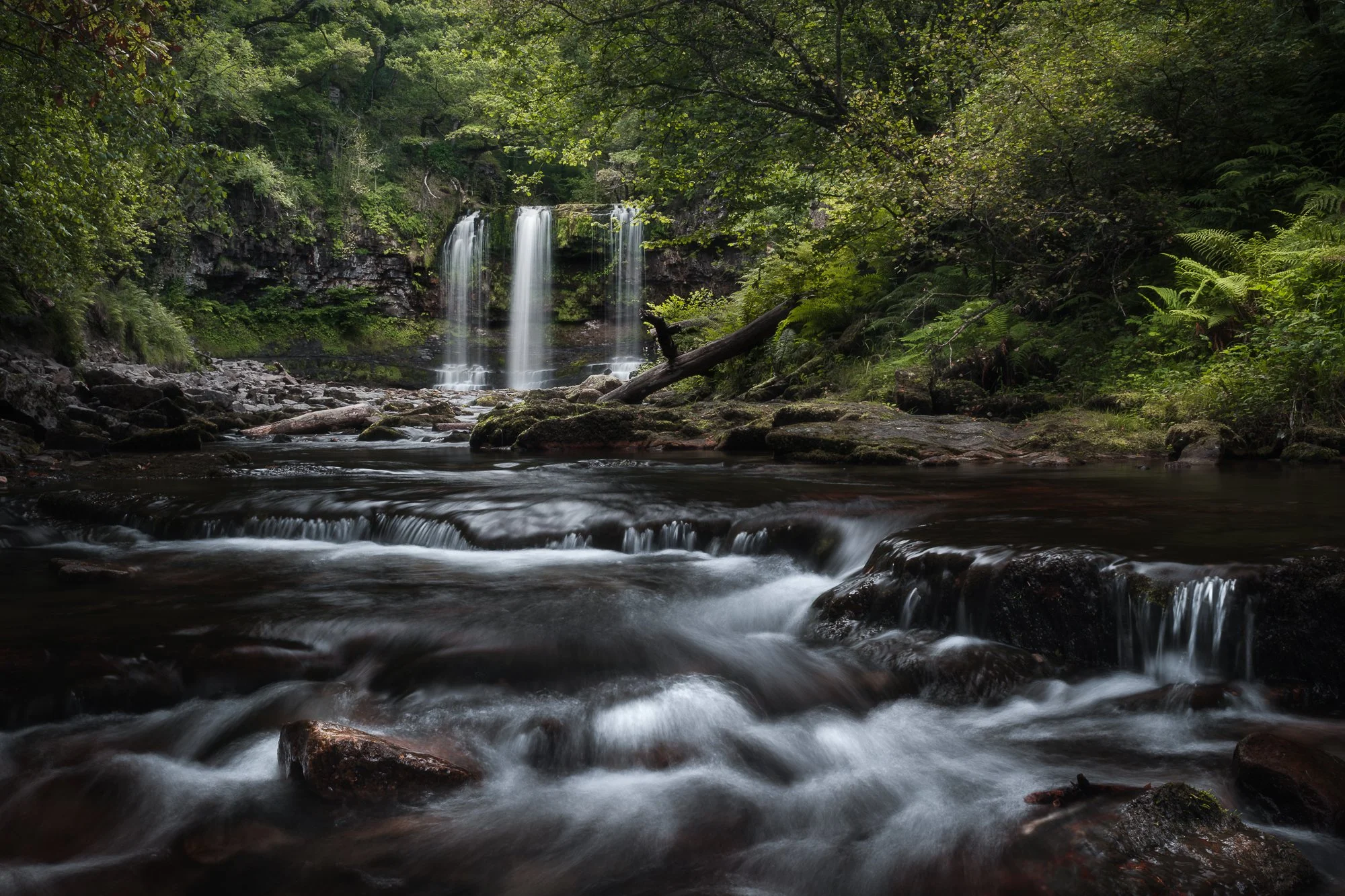
Fujifilm XT5 | XF16-55mm | 23mm | 0.8 Seconds | f/16 | ISO125
A quick stop at Blaen-y-glyn Falls
Before heading home, I made one last stop at the Blaen-y-glyn Falls. My expectations for waterfall photography were quite low, as the flow was just as light here as it had been along the Elidir Trail. Still, I made a point of visiting, wanting to explore and see how the place looked in summer. I did get my camera out a couple of times and took a few scouting shots, but only one made the cut to be featured below.
This composition is similar to one I photographed on a previous visit, though back then the greens were more subdued and there was more water falling onto the log wedged solidly at the base of the waterfall. I like the subtlety of the water as it falls, framed by a wall of green moss and plant life, and I find it interesting how the fallen branch has come to rest exactly where the water lands, sticking out from the wall at an almost perfect 90-degree angle. Using a similar composition to the one I captured the previous year, I took this final photo of the trip.
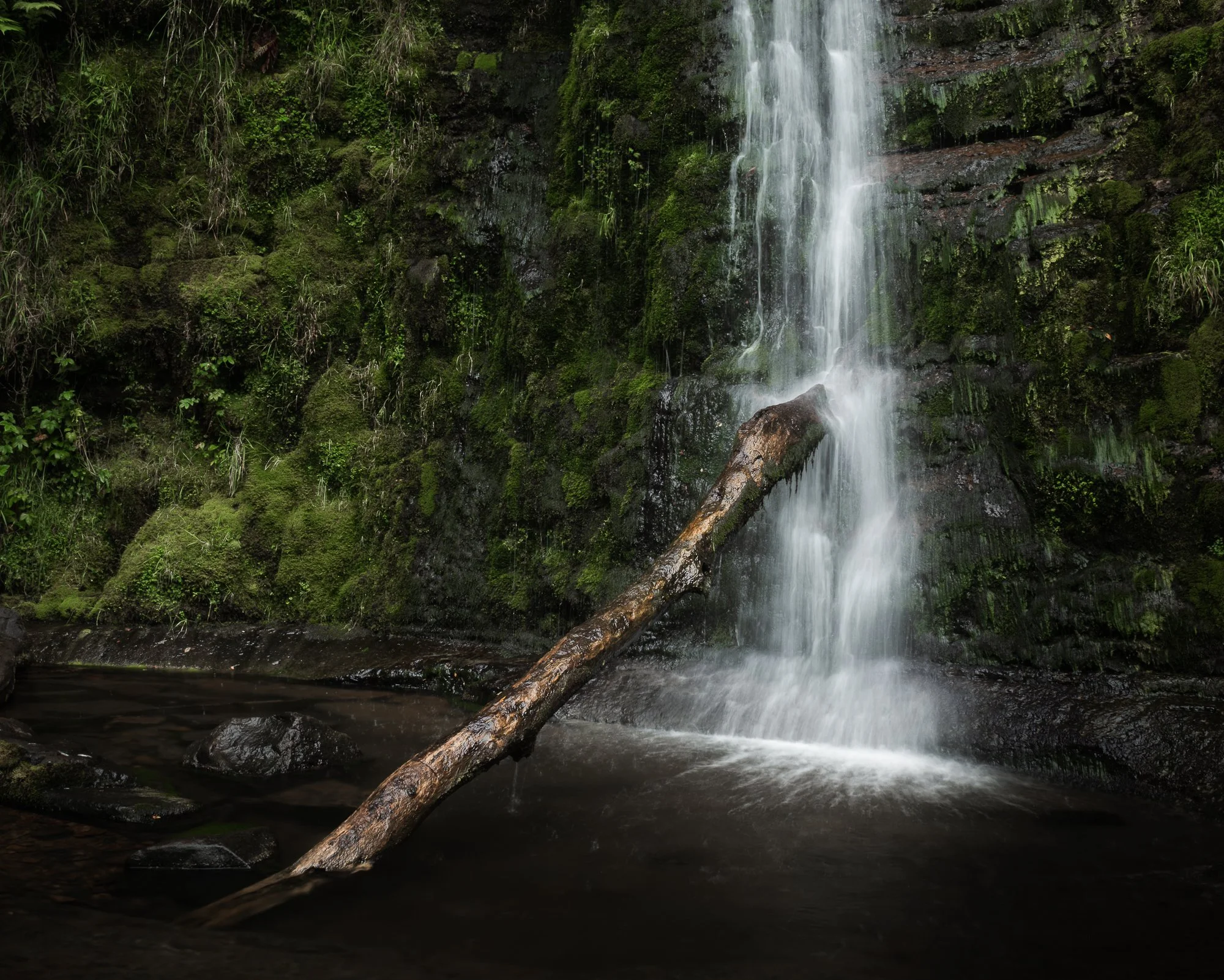
Fujifilm XT5 | XF16-55mm | 25mm | 0.4 Seconds | f/14 | ISO125
That’s it for another trip to this beautiful location in the Brecon Beacons, Wales. If you want to read about some of my previous trips photographing the falls in the spring and autumn months, check out the links below.
Until next time,
Trevor


Landscape Photography in Snowdonia
A landscape photography trip to Snowdonia/Eryri in north Wales in March 2025.
A few months ago, in late March, I spent several days in Snowdonia (Eryri) with my camera, exploring and photographing its strikingly rugged landscape. As with previous trips to North Wales, I had a few locations I wanted to visit, but I also left plenty of room in my plans for spontaneous detours, exploring areas I may not have been to (or even researched) before.
I set off early on the first day, arriving at the car park in the Ogwen Valley around lunchtime and not wanting to waste much time, I set off for a circular hike up and around the Glyders.
While most of the photos I took on this trip are in colour, there were moments when the subject and lighting naturally suited a monochrome treatment. I’ve chosen to group all the black and white images at the end of this post, not because they were an afterthought, but because I believe they work best when presented together, so stick around to the end of this blog to see them.

Fujifilm XT5 | XF10-24mm | 15mm | 1/125th Second | f/8 | ISO125
From the path leading from Ogwen Cottage towards Llyn Idwal, I veered left midway along the Cwm Bochlwyd Path, past Llyn Bochlwyd and made my way up Y Gribin (The Ridge). The last section of Y Gribin was rather technical with some scrambling needed as I plotted my path up towards Bwlch y Ddwy Glyder (Pass of the Two Glyders), but once there, I was greeted with some cracking views towards Tryfan and across the Ogwen Valley.
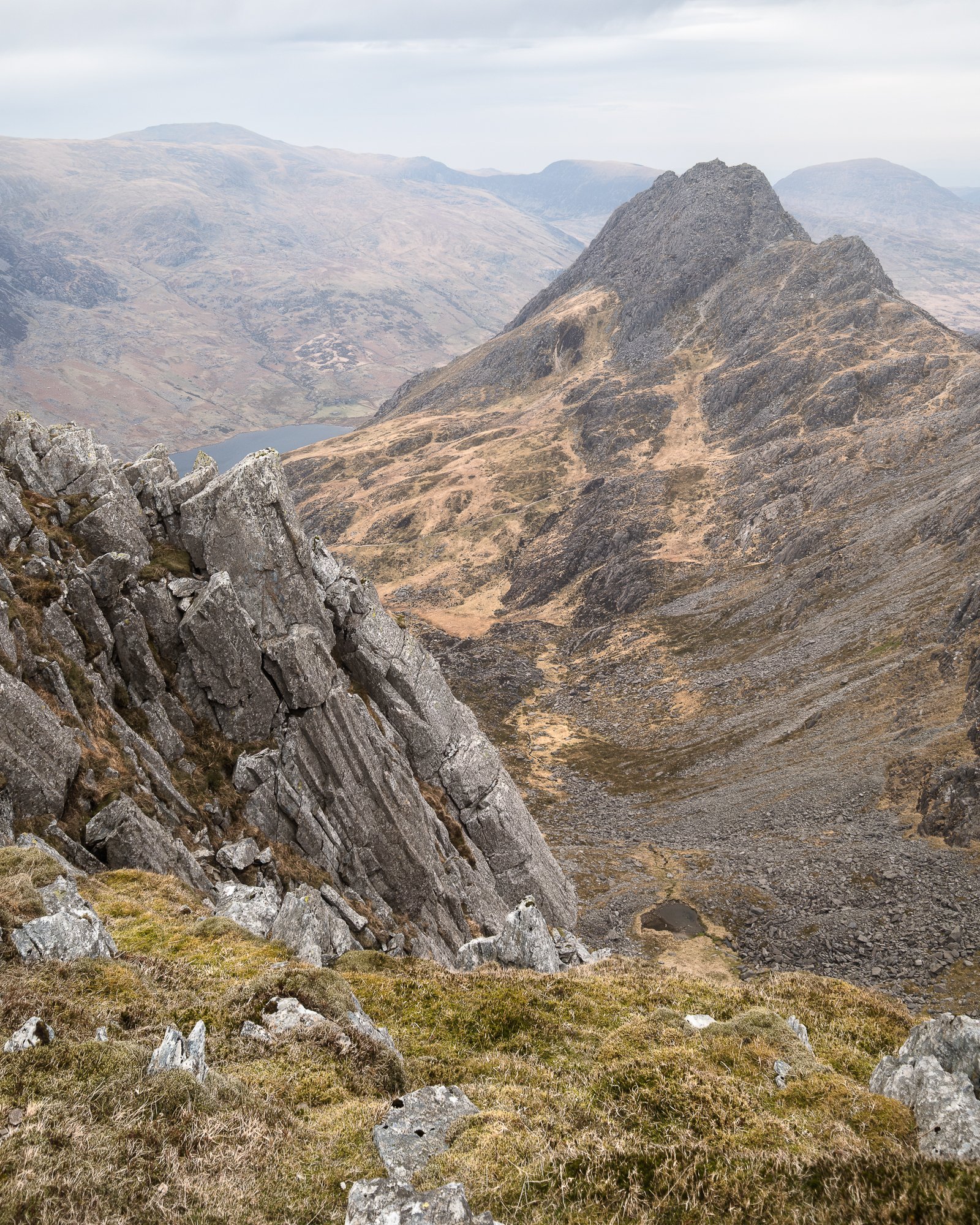
Fujifilm XT5 | XF10-24mm | 18mm | 1/100th Second | f/7.1 | ISO125

Fujifilm XT5 | XF10-24mm | 11mm | 1/60th Second | f/9 | ISO125
As you can see from this view looking west toward Y Garn, the light was fairly flat that afternoon, which, in hindsight, summed up the tone of the entire trip. During my three days in Snowdonia, I can only recall one or two brief moments of direct sunlight. That wasn’t necessarily an issue for me, as I’m not a big believer in ‘bad’ or ‘wrong’ light; I just need to adapt and make the most of the conditions I’m given.
With distant views defused slightly by the haze, I chose to stick with my 10–24mm wide-angle lens and focus on the textures and forms of the rocks as the primary subject in this set of images. I also used my Kase circular polariser throughout the afternoon, which helped cut through some of the haze, adding a touch of clarity and a bit more punch to the final shots.

Fujifilm XT5 | XF10-24mm | 13mm | 1/100th Second | f/8 | ISO125
From Bwlch y Ddwy Glyder, I headed west toward Glyder Fawr, and as I climbed toward the summit, I came across this imposing jagged rock formation jutting up into the sky. Trying to capture some of the awe and dominance the structure was projecting as I stood beneath it, I moved in closer, staying low, and manoeuvred around until I landed on the composition you see here.

Fujifilm XT5 | XF10-24mm | 19mm | 1/60th Second | f/8 | ISO125
At just over 1,000 metres, Glyder Fawr is the highest peak in the Glyderau range and photographing the area around its peak was my favourite part of this walk around the Glyders. The rock formations appeared otherworldly and made for some interesting subjects to photograph. According to Sir Ifor Williams (a Welsh scholar), the word "Glyder" derives from the Welsh word "Gludair", meaning a heap of stones, and that’s a pretty accurate description of the landscape up there.
This location provided great views across the Nant Peris valley towards the Snowdon massif, and contrary to the flat, featureless clouds I had around me on the Glyderau massif, the clouds towards the south were a lot more dramatic, and none more so than in this photo below where the clouds seemed to converge directly above Snowdon. Composing so that the fractured stones in the foreground mirrored those interesting cloud formations in the sky, I took the photo below, which turned out to be my favourite of the day, maybe even my favourite of the entire trip to Snowdonia.

Fujifilm XT5 | XF10-24mm | 10mm | 1/60th Second | f/8 | ISO125
As I explored the peak further, I looked for different ways to make interesting compositions of the incredible rock formations. After taking the photos below, I used some dodging and burning in post-processing to enhance the subtle light falling across the landscape. This helped to separate the various layers and added a stronger sense of depth as the rocks stretched out before me.

Fujifilm XT5 | XF10-24mm | 10mm | 1/40th Second | f/9 | ISO125

Fujifilm XT5 | XF10-24mm | 10mm | 1/60th Second | f/11 | ISO250
After spending some time on Glyder Fawr’s summit, it was time to make my way downhill towards Llyn Y Cwm (Lake of the Dogs) and over to Y Garn, the final peak I’d be summiting before making my way back down towards Llyn Idwal. The descent towards the small lake was tricky as it was steep with lots of loose scree, so I had to tread carefully as I made my way down.

Fujifilm XT5 | XF16-55mm | 43mm | 1/60th Second | f/9 | ISO250

Fujifilm XT5 | XF16-55mm | 16mm | 1/100th Second | f/9 | ISO250
After navigating that rather sketchy 250-metre descent, I arrived at the top of the Devil’s Kitchen and from here, I had some great views of Tryfan and the Ogwen valley. It was at this point that I felt “inspired” to take the selfie below. The views were stunning, but I wanted to demonstrate the scale of the landscape and placing myself in the scene was a way I could achieve that.
With the selfie taken, I made my way up to Y Garn and then back down the mountain to Llyn Idwal.

Fujifilm XT5 | XF16-55mm | 43mm | 1/125th Second | f/9 | ISO125

Fujifilm XT5 | XF10-24mm | 20mm | 1/60th Second | f/10 | ISO125
While passing Llyn Idwal on my way back down, there was some nicely diffused light hitting the steep, rocky face of Glyder Fawr, and I thought it would round the hike off nicely to get a photo from ground level of the peak I’d not long been standing atop just an hour or two before.
This is a popular spot to photograph Cwm Idwal, but instead of trying to get the entire lake and valley in the frame, I decided on a vertical composition, which gave me the room needed to include more of the foreground rocks in the photo. It was a tricky one to compose as achieving a balanced feel depended on how the foreground was arranged, and with a little shuffling left and right, I landed on this composition here, which I think, to my eye at least, works well.

Fujifilm XT5 | XF10-24mm | 10mm | 0.8 Seconds | f/13 | ISO125
The next and final stop of the day was over on the opposite side of the valley at this popular spot along Afon Lloer. It’s a popular location as this vantage point provides a fantastic view of Tryfan and the Glyderau Massif behind.
It’s a composition I’ve photographed on each of my previous visits to Snowdonia and feel I’ve never quite come away with a picture good enough to put the location to bed. There’s always something I’m not happy with, and with the clouds starting to thin and the sunlight hitting the landscape for the first time that day, maybe this would be the time I get “the shot”.
I mentioned previously that I had just one or two periods of direct sunlight on this entire trip, and this was one of them. Just as the sun was dipping, it illuminated the top half of Tryfan, and I had just enough time to fire off a few photos, with this one below being the best of those I took.

Fujifilm XT5 | XF10-24mm | 10mm | 1/10th Second | f/8 | ISO125

Fujifilm XT5 | XF10-24mm | 10mm | 0.5 Seconds | f/9 | ISO125

Fujifilm XT5 | XF10-24mm | 10mm | 0.5 Seconds | f/14 | ISO125

Fujifilm XT5 | XF10-24mm | 10mm | 0.4 Seconds | f/14 | ISO125
The next morning, I drove along the Nant Gwynant valley to photograph Snowdonia's second most famous lone tree. I like the way this old tree emerges from behind the rock with its branches reaching up into the sky, splitting the valley in the background and having seen it photographed a few times before, I decided to pop down to see what I could make of it.
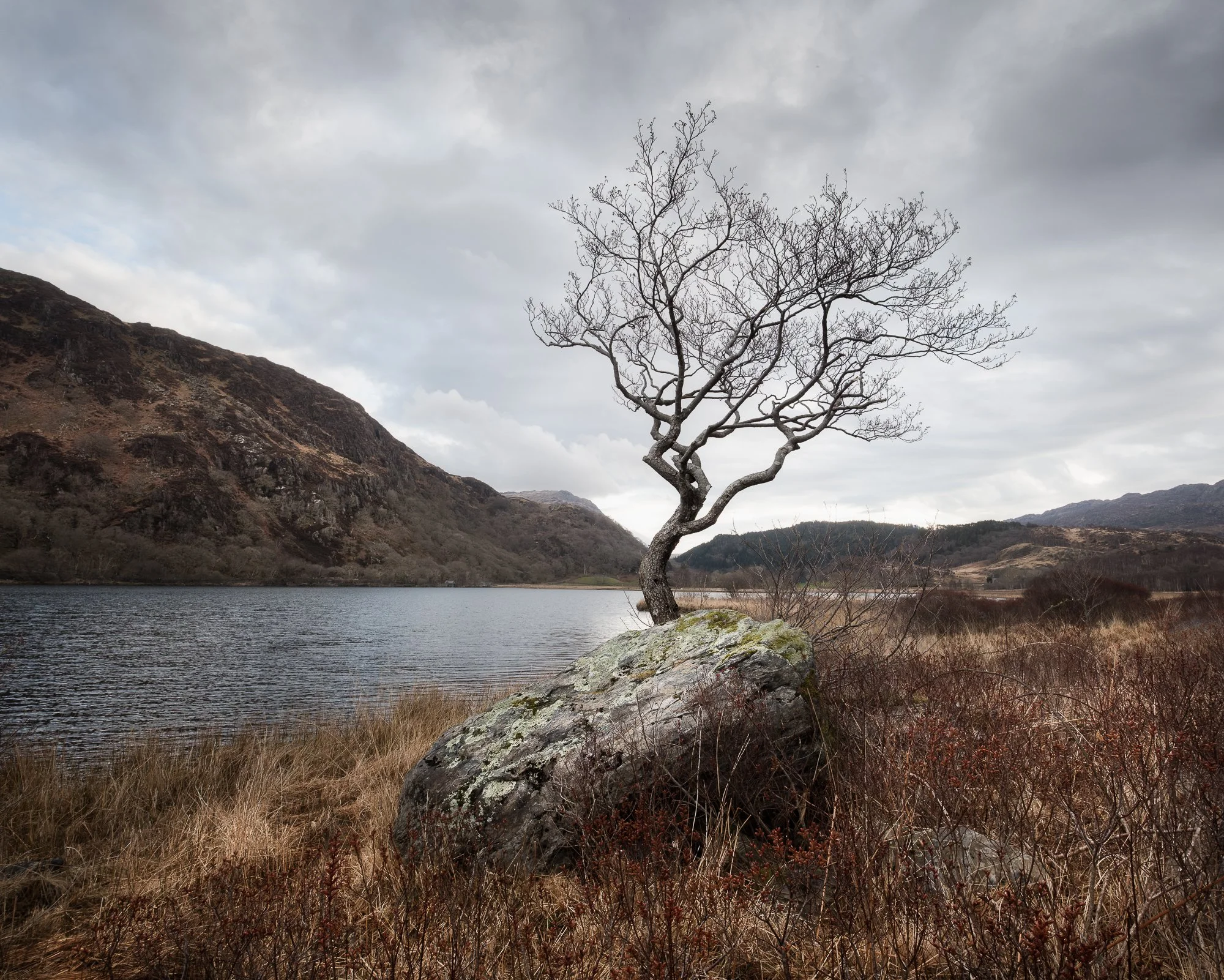
Fujifilm XT5 | XF10-24mm | 12mm | 1/100th Second | f/10 | ISO400
Compositionally, the two most important factors for me were to ensure the tree was positioned correctly in the centre of the valley’s “V” shape and that my camera was close enough to the ground so that the lowest branch didn’t overlap and get lost in the background. I took a photo in both landscape and portrait orientations and feel the landscape version just about wins as the tree has more space around it, particularly on the right.

Fujifilm XT5 | XF10-24mm | 13mm | 1/100th Second | f/9 | ISO400
Although I had my drone with me throughout the trip, for various reasons I didn’t use it as much as I thought I would, but while standing next to the lake, I was curious to see how the valley would look from up high.
This would be the second and last time I would see the sun hitting the landscape during this trip. As the drone gained some altitude, the clouds briefly parted, illuminating the south-eastern side of the Snowdon Massif. The light didn’t last long, but I managed to take this aerial photo before it disappeared again.

DJI Mini 3 Pro | 24mm (effective) | 1/640th Second | f/1.7 | ISO100
One thing I wanted to achieve during this visit to Snowdonia was to explore new (to me) areas without researching any particular photo spots, enabling me to come away from the trip having photographed both well-known and lesser-known locations. This was the case on the previous day during my walk around the Glyders as although I had researched the route, I hadn’t researched any photographic compositions. With this in mind and once finished photographing beside the lake, I headed off on a small circular walk around the eastern side of the valley to gain a little elevation and explore this area further.
By this point, there was plenty of ambient light, but it was nicely defused by the clouds and not too long after leaving the side of the lake, I came across this small stone building nestled perfectly in the landscape. I continued past the cottage to get to a bit higher, and with the mountains providing a great backdrop, out came the camera, and I took this photo below.

Fujifilm XT5 | XF16-55mm | 32mm | 1/25th Second | f/11 | ISO125
With the lovely, defused light, this scene, with the traditional stone building set in the landscape, has a timeless, painterly feel, which I like a lot. However, in the spirit of staying transparent to those who read this blog, the building (which is actively used) has a modern solar panel on the side of the roof and it didn’t fit with the look and timeless feel I wanted to achieve with this picture, so I used some artistic license and cloned it out.
Working my way around this small circular walk in the Snowdonia hills, I came across this unassuming cascade of water tumbling down one of the hills. Ordinarily, I might have carried on walking, and I very nearly did, but I decided to stop and spent a few minutes composing this small scene nestled in the landscape. Using a combination of a circular polarising and 3-stop neutral density filters, I was able to slow the shutter speed and take some of the glare out of the scene.

Fujifilm XT5 | XF10-24mm | 11mm | 0.8 Seconds | f/9 | ISO125
Later that day, I made my way back across to the Ogwen Valley as I had some unfinished business with an elevated scene I’d attempted to photograph on my way back down from Y Garn on the previous day. On that previous attempt, the conditions weren’t great for photography as the light was flat and with so much distance between the camera and the subject, the hazy conditions left a lot to be desired.
Fast forward a day, and the conditions had improved. The sky offered more visual interest, and soft, dappled light was falling on the landscape, highlighting its contours and adding depth. It wasn’t perfect by any means, but it was certainly good enough to pull the camera out and start composing a few shots.
It’s a composition that unfortunately slices through Llyn Idwal, but necessary if I wanted to keep Tryfan fully in frame as a main focal point and after waiting a short while for some light to fall on Tryfan’s peak, I took the image below, had a snack and then made my way back down the slope.

Fujifilm XT5 | XF16-55mm | 19mm | 1/60th Second | f/11 | ISO125
I’m fascinated by the shapes, lines and textures on the rocky face of Glyder Fawr, and while passing by on my way back to the car park, I noticed some subtle light bouncing off it. Out came the camera once more, and composing a square crop to help with the balance, I took this photo below.
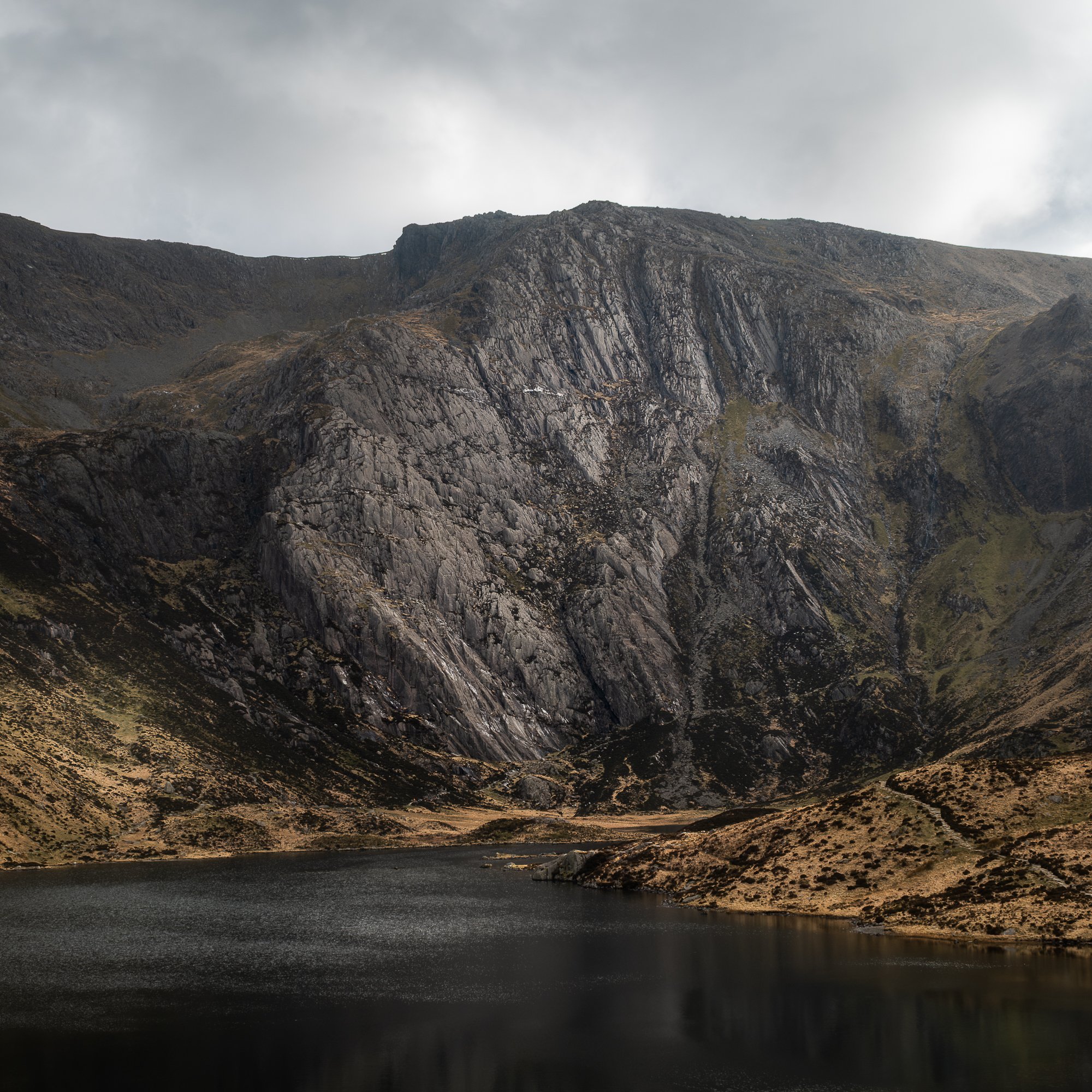
Fujifilm XT5 | XF16-55mm | 27mm | 1/80th Second | f/8 | ISO125
For the last stop of the day and with the clouds starting to clear, I wanted to get a view of the valley looking towards the west. I headed a couple of miles east along the A5 to an elevated spot along the path that takes you up to Ffynnon Llugwy, a mountain lake and the source of Afon Llugwy. I didn’t hike all the way up, just enough to get a better view of Tryfan and the Glyders behind.
I took a few photos with the telephoto lens but wasn’t really happy with what I was seeing. The scene was too busy and the light on the landscape wasn’t particularly great either. So, after some experimentation with focal lengths and with the afterglow of the sun casting some lovely pastel colours across the sky, I took this wider, silhouetted picture of the view in front of me. I like the abstract nature of this photo and feel the strong shapes of the mountains against the softly lit sky behind work well.

Fujifilm XT5 | XF16-55mm | 32mm | 1/4 Second | f/11 | ISO125
The forecast for the following morning called for low cloud cover and rain, so I opted against heading to any of the higher elevations where visibility would be severely limited. Instead, I began the day by revisiting the lone tree in the Nant Gwynant valley. With cloud levels expected to drop as low as 100–200 metres, I anticipated near-zero visibility, ideal conditions, I hoped, for capturing the tree as a minimalist subject, standing quietly in the misty, rain-soaked landscape.
As you can see, from this spot at least the rain had yet to start, and the clouds weren’t quite low enough. I took a couple more photos while I was there and headed back to the car.

Fujifilm XT5 | XF10-24mm | 13mm | 1/30th Second | f/11 | ISO400
Before travelling home later the same day, I’d planned a little time around Llanberis and the famous Dinorwig Slate Quarry. With low cloud and rainy conditions expected, I was hoping to use them to my advantage and capture some mist and mood in my photos, but before heading to the quarry, I made a quick stop at Dolbadarn Castle.
It’s a location I’d seen many times from afar but never actually visited, and I was keen to have a good look around, maybe take a picture or two while there. By the time I arrived, the rain was falling quite hard, and after having a look around, reading some of the information boards about the castle’s history, I composed this atmospheric photo below of the castle and partly obscured Snowdon range in the background.

Fujifilm XT5 | XF10-24mm | 14mm | 1/80th Second | f/8 | ISO125
Leaving Dolbadarn Castle, I made my way up to Dinorwig Quarry. I wanted to have a good explore and photograph what caught my eye, and first up, as I made my way towards the Anglesey Barracks, these old trees grabbed my attention.

Fujifilm XT5 | XF16-55mm | 23mm | 0.6 Seconds | f/11 | ISO125
As mentioned before, I don’t subscribe to the notion that there is good and bad light. In my opinion, different subjects work in different light, but if I’m being honest, the light I had to photograph both the trees above and the barracks below was flat and uninspiring. I was struggling a bit.
I don’t mind the composition I found of the Anglesey Barracks below as it provides a useful frame around the subject, and the picture feels a little painterly, which I also like. That being said, I feel that with more interesting sidelight or a little mist, both pictures could have been so much better. A location to return to, I think.

Fujifilm XT5 | XF10-24mm | 14mm | 1/8th Second | f/10 | ISO125
Dotted around the quarry are a few lone trees that seem to be growing out from the hills of slate, and I used this one below as a subject with a distant view of Dolbadarn Castle in the background. The rain in the air had defused the background, allowing the tree to stand out as the main subject, and I opted to zoom in a little to make the tree more of a feature, giving the image a slightly more intimate feel.

Fujifilm XT5 | XF50-140mm | 84mm | 1/50th Second | f/2.8 | ISO125
Further up the hill, I found myself standing on the edge of a pool of water called Sinc Harriet. After heavy rain, the volume of water in this pit can rise rapidly, but I guess there hadn’t been too much rain before my visit, as the levels were quite low. So low in fact, the slate rubble beneath was visible, and with the wind creating some ripples on its surface, I spent some time creating some abstract images, all with a slight painterly feel thanks to the texture on the water.


Moving on from Sinc Harriet, and with visibility on the low side, I set off along the path to capture some small, intimate views of the quarry. Although I’ve been a fan of the square crop for a while now, I’ve grown to appreciate how well it suits small scenes like this. With a square crop, I find it easier to achieve balance as no one side is dominant, and it allows me to be more creative with my compositions.

Fujifilm XT5 | XF16-55mm | 55mm | 1/200th Second | f/8 | ISO230

Fujifilm XT5 | XF16-55mm | 44mm | 1/30th Second | f/8 | ISO320
My last stop before driving back to leafy Surrey was at the lone tree in Llanberis. In the photography community at least, it’s quite a popular scene and having visited once before in less than ideal conditions for my style of landscape photography, I decided to pop by to see what I could make of it this time.
Down by the lake, the visibility was better, but like it was up at Sinc Harriet, the water levels here were also low. Not to be deterred, I lowered the camera down, using the exposed rubble to build a bit of a foreground and making sure the tree was positioned correctly, centred in the distant valley, I took the photo.

Fujifilm XT5 | XF10-24mm | 12mm | 1/40th Second | f/10 | ISO125
As I mentioned at the beginning of this post, I processed some of the photos I took on this trip in black and instead of injecting them in-line alongside the other photos, I wanted this collection to stand on its own as a black and white set.
Some of the pictures I’ve shared below are monochrome renderings of the same colour photos from above, but a few of them are unique to this set, consciously taken to be produced as black and white photos.

Fujifilm XT5 | XF10-24mm | 10mm | 1/100th Second | f/10 | ISO400

Fujifilm XT5 | XF16-55mm | 35mm | 1/25th Second | f/16 | ISO400

DJI Mini 3 Pro | 24mm (effective) | 1/6400th Second | f/1.7 | ISO100
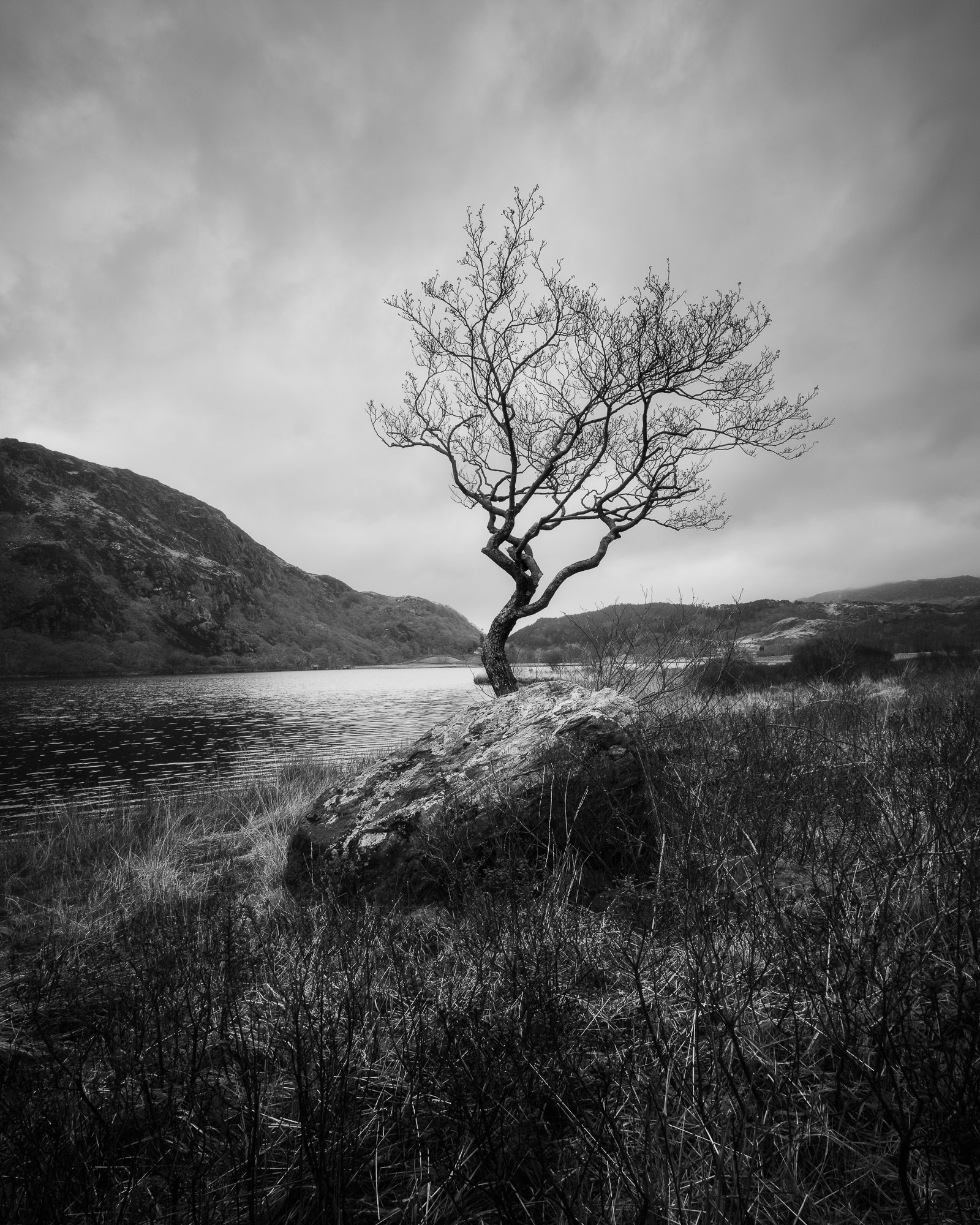
Fujifilm XT5 | XF10-24mm | 10mm | 1/30th Second | f/11 | ISO400

Fujifilm XT5 | XF10-24mm | 14mm | 1/80th Second | f/8 | ISO125

Fujifilm XT5 | XF70-300mm | 300mm | 1/125th Second | f/8 | ISO400

Fujifilm XT5 | XF16-55mm | 55mm | 1/200th Second | f/8 | ISO230

Fujifilm XT5 | XF16-55mm | 44mm | 1/30th Second | f/8 | ISO320

Fujifilm XT5 | XF16-55mm | 19mm | 1/40th Second | f/11 | ISO125

Fujifilm XT5 | XF10-24mm | 12mm | 1/40th Second | f/10 | ISO125
That’s a wrap for another landscape photography trip to Snowdonia, but if you want to see more photos of this stunning landscape in North Wales, I’ve written some more blog posts and shared many more pictures, which you can find links to below.


As ever, if you have any questions or suggestions, please leave a comment below. Otherwise, thanks for stopping by.
Until next time.
Trevor

A Late Autumn Trip to the Brecon Beacons Waterfalls
A late autumn trip to photograph the waterfalls in the Brecon Beacons.
I’ve been making my annual trip to photograph the waterfalls in the Brecon Beacons for a few years now and although this year was no different, due to other commitments, I was limited as to when I could travel and ended up scheduling this year’s trip in mid-November.
Photographically (and in my opinion), the waterfall trails look their best while there are still plenty of leaves on the trees. Apart from adding life and colour to the woodland scenes, when the trees have their leaves, it helps to limit how much of the brighter sky creeps into the frame, as it can be incredibly distracting when composing the photos. With it being a few weeks later than I would have ideally wanted to visit, I was concerned I may not come away with anything of note this time.
Spoiler alert, I was right to be concerned as shortly after I arrived it became clear that most of the trees were now void of their leaves. I didn’t, however, allow it to sway my enthusiasm to push on and make the best of my time there, I just had to be prepared to dig a little deeper to get a keeper or two.

Looking up towards some cascades at the Blaen-y-glyn Falls
In previous posts about my trips to the Brecon Beacons, I’ve shared some extra information to help people looking to visit and photograph this fantastic area of Wales. In this post, I’ll refrain from repeating myself, but, if you’re after some additional info such as the best places to park, etc, you’ll find that in my previously published articles about my trips to the Brecon Beacons which added to the end of this article for your convenience.
The Four Falls Walk
During the trip, I spent much of my time along the Four Falls Walk and this section of the blog includes some of the photos I took there. The flow along Afon Mellte and Afon Hepste wasn’t particularly strong but there was just enough water to create some interesting compositions as it made its way down the valley.
I started this photography trip here, opposite Sgwd Clun Gwyn Uchaf. It’s a little tricky to get to, but I think this vantage point provides the best view of the falls. The first image is one I’ve taken before but something I noticed while there is that without any leaves to block the view, I was able to shoot from behind the trees, using the trunks to add a frame within a frame. You can see this in a few of the photos I’ve shared below. They are compositions that probably only work after the leaves have fallen and a good reminder that even when conditions aren’t what you intended, there are always new photographic opportunities to discover.

Fujifilm XT5 | XF10-24mm | 10mm | 1/3rd Second | f/13 | ISO125

Fujifilm XT5 | XF10-24mm | 10mm | 1/2 Second | f/13 | ISO125

Fujifilm XT5 | XF16-55mm | 32mm | 0.4 Seconds | f/14 | ISO125

Fujifilm XT5 | XF16-55mm | 27mm | 1.3 Seconds | f/10 | ISO125
Although there were a few trees clinging on to their autumnal colours dotted around (as pictured above), most of that autumn colour was now lying around on the floor and by looking for ways to include these fallen leaves in the image, I could still communicate what time of year the pictures were taken.
The leaves provided some fantastic foreground details and by getting low, as I did here at Sgwd Yr Pannawr, I was able to use them to help build a more interesting composition of the waterfall.

Fujifilm XT5 | XF10-24mm | 11mm | 1.3 Seconds | f/14 | ISO125

Fujifilm XT5 | XF10-24mm | 21mm | 0.8 Seconds | f/11 | ISO125
While photographing Sgwd Yr Pannawr, I took the opportunity to wander back upstream a few hundred metres to this spot alongside Sgwd Clun Gwyn Uchaf. I tried a few different places to get an interesting composition here, even climbing down and getting closer to those rocks below my feet, but I found that the lower I descended, the more of the sky crept into the frame, creating a rather large and distracting highlight at the top of the image.
After a little trial and error, nothing seemed to work and I soon realised that I needed to keep things simple and of all the photos I took, this classic composition of the falls was the one I liked the most.

Fujifilm XT5 | XF10-24mm | 13mm | 0.4 Seconds | f/14 | ISO125

Fujifilm XT5 | XF50-140mm | 56mm | 1 Second | f/11 | ISO125
Needing no introduction is Sgwd Yr Eira. A popular spot along the trail, particularly as it provides the unique opportunity for those visiting to walk directly behind the waterfall and because of this, there tends to be a lot more people here throughout the day. It’s for this reason i like to come here earlier in the morning as I often find myself here alone, allowing me to work on various compositions without needing to wait for people to move out of my frame.
I tried and failed to make use of what was left of the leaves along the banks so instead, used the cascades in the water to add some foreground interest to my compositions. Without too much water flowing downstream, the river was shallow enough for me to wade out towards the middle, and by playing around with different focal lengths and shutter speeds, I had a great time finding different ways to photograph the water with the falls in the background.

Fujifilm XT5 | XF10-24mm | 12mm | 0.8 Seconds | f/9 | ISO125

Fujifilm XT5 | XF10-24mm | 12mm | 0.4 Seconds | f/9 | ISO400

Fujifilm XT5 | XF16-55mm | 25mm | 1 Second | f/10 | ISO125
The Elidir Trail
Moving on from my time along the Four Falls Walk, I also spent a little time along the Elidir Trail. I typically prefer to photograph this area in overcast conditions as it avoids having to deal with harsh contrast and specular highlights across the scene but during this trip, the weather was a bit all over the place with long periods of clear skies. Along the Four Falls Walk, this is a little easier to deal with as the walls along the gorge are typically a lot higher, shading the falls from the sun but along the Elidir Trail, a lot more of the sunlight can creep into the scene and I struggled with this brighter light a lot more when the sun made an appearance. For that reason, and with there being very little foliage left, I only managed to take a couple of waterfall photos I’m happy with.

Fujifilm XT5 | XF10-24mm | 13mm | 5 Seconds | f/13 | ISO125
I took my first image above at Sgwd Gwladus (Lady Falls) and with the best composition being obvious (and for that reason shot a million times before), I find the trick to this location is to look for objects around the water to add compositional interest. During previous visits to this spot, I used the ferns for some foreground interest but this time, I found this large branch on the water’s edge and used it to add interest, a frame and a lead in line towards the falls.
The second waterfall photo I liked from those I took along the Elidir Trail was this one below at Sgwd Ddwli Isaf (Lower Gushing Falls). To add a little drama to this modestly sized cascade, I placed the camera close to this small overhand and once again, I used the fallen leaves on the rocks to provide a sense of time as well as a little interest to the lower part of the frame.

Fujifilm XT5 | XF10-24mm | 11mm | 1.3 Seconds | f/18 | ISO125
As I did along the Four Falls Walk, I also tried to photograph some alternative, intimate compositions such as the two I’ve shared below. Both are very different subjects but to my eye at least, they share a similar sense of natural chaos which I had fun trying to make a composition from.

Fujifilm XT5 | XF16-55mm | 31mm | 0.6 Seconds | f/11 | ISO125

Fujifilm XT5 | XF16-55mm | 55mm | 1/15th Second | f/8 | ISO125
The Blaen-y-glyn Falls
One thing I try to do on each trip to the Brecon Beacons is visit at least one new location and this time, I decided to drive across to explore the Blaen-y-glyn Falls. This circular walk is quite straightforward but soon after I arrived it became apparent that conditions were not optimal, and photos would be hard to come by. To get the best photos, I feel it’s an area that benefits a lot from fuller foliage and stronger flow in the river and having none of these, this visit quickly became a scouting opportunity.
I did, however, take a couple of photos from an offshoot to the main waterfall route which I came across as I made my way up the valley. With the sun to the south and these cascades running more west to east, enough of the harsh sunlight was blocked and by getting in close to the falls, I was able to add a little drama to the final composition. You can get a better idea of the size of these falls from the selfie photo I shared at the beginning of this article.
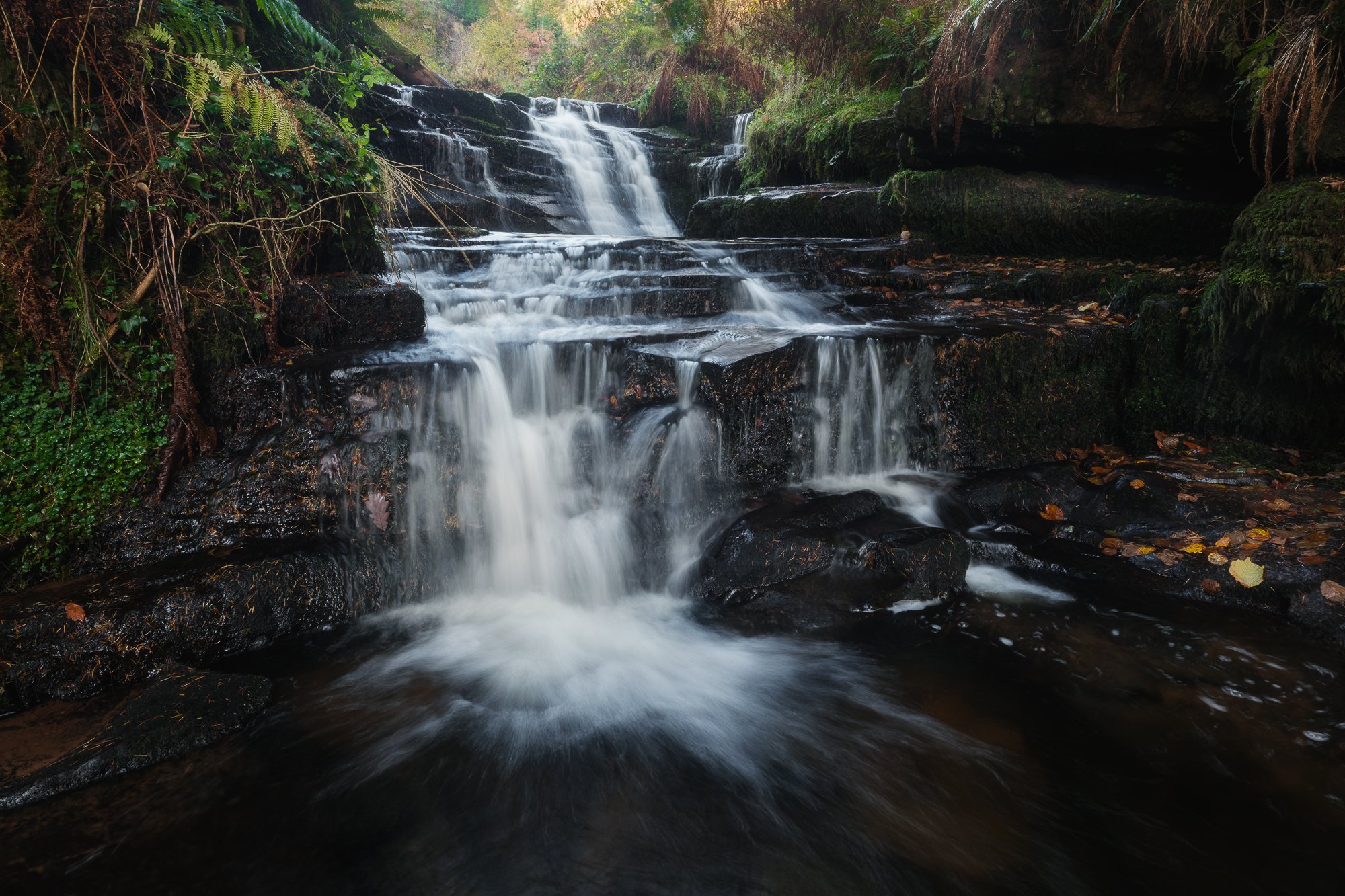
Fujifilm XT5 | XF10-24mm | 13mm | 1/2 Second | f/9 | ISO125
Climbing higher along this small offshoot I came across another waterfall, much taller than the one above but again, one I found tricky to photograph in its entirety. Noticing this fallen branch wedged at the base of the falls, I moved in a bit closer and composed an image around it. The falling water was like a spotlight pointing down towards the branch which I positioned to the left of me, creating a useful diagonal line, anchoring the composition nicely.
I love the mood, the simplified arrangement and balance offered by the square crop and by playing around with both long and short exposures, I ended up with these two versions below. I struggled to choose a favourite from the two, so I’ve included them both.

Fujifilm XT5 | XF16-55mm | 31mm | 30 Seconds | f/9 | ISO125

Fujifilm XT5 | XF16-55mm | 32mm | 0.8 Seconds | f/9 | ISO125
Sychryd Falls
The last stop on my tour of Waterfall Country was here at Sychryd Falls. Although I knew the trees would be bare, I was hoping there would be plenty of leaves on the rocks to use to build a new composition but as you can see, there were some, enough to get a sense of time, but nowhere near enough to create a feature of them.
In the end, the scattering of leaves played a supporting role, and I used the small cascades and ferns closest to me to build a strong foreground, leading the eye towards the main falls and bridge in the background.

Fujifilm XT5 | XF10-24mm | 11mm | 1/2 Second | f/10 | ISO125
Looking back as I write this post, I’m pleasantly surprised by how many photos I like and was able to share from this recent trip to the Brecon Beacons. Spoiled by amazing conditions on previous visits, there were many a time I had to dig deep to overcome an initial feeling of being underwhelmed by the scene in front of me, but after having many words with myself to look deeper and think outside the box, I found myself driving home with images I was excited to start processing.
As I mentioned, here are two articles documenting a couple of my previous trips to Waterfall Country which also include some useful information to help those visiting this location for the first time.


Feel free to share your thoughts in the comments below.
Until next time.
Trevor
Photographing Snowdonia in Late Spring
Landscape photography from my trip to Snowdonia in late spring
Since I made my first dedicated photography trip to Snowdonia back in January 2023, I’ve become a little obsessed and have returned a few times for a bit of landscape photography. Before now, I’d only visited during the colder months, so I could photograph a more wintry-looking landscape, but I also wanted to visit at other times of the year as there were certain locations I knew would look better between spring and autumn.
In May this year, I spent a week staying in Betws-y-Coed, a village on the edge of Snowdonia with my family. It wasn’t a dedicated photography trip, but I still made sure to carve out some time here and there to head out on my own to indulge in some landscape photography and in this blog post, you’ll find some of the photos I took during the trip.
Photographing Fairy Glen
Being late spring and with the woodland full of vibrant colour, Fairy Glen was at the top of my list of places to photograph during this visit. Located just a few minute’s drive from Betws-y-Coed, Fairy Gen is a narrow gorge along the River Conwy.
I’d seen countless photos taken at this spot and the ones I was drawn to the most were those that included plenty of foliage, which I feel brings this location to life. So, knowing that any time between late spring and autumn would be ideal, I set my alarm to arrive shortly after sunrise.
As you can see, I was not disappointed. It looked exactly how I’d hoped; better even. There was so much colour in the scene, helped by the fact that it was raining as I arrived, and the wet leaves were even more saturated.

Fujifilm XT5 | XF16-55mm | 34mm | 10 Seconds | f/10 | ISO125
I started off with the classic view looking directly through the gorge. The rocks were wet and slippery so word of warning for anyone visiting in similar conditions. I made a feature of the bubbles created by the water cascading over the rocks by using an ND filter and a longer exposure to capture them as they made their way downstream towards me. Luckily there was no wind down there, so I didn’t have to worry about the leaves moving around while the picture was taken.
I tried a few different compositions and crops and took a few photos I liked but the one above is my favourite from that vantage point.
Moving off the slippery rocks and to the side of the river, I wanted to find a slightly different composition from those I’d seen before. Being such a small spot, I doubt I could find a unique photo but after a bit of trial and error, I found the composition seen below. Maybe not unique but certainly new to me. I purposely placed the green leaves towards the bottom left of the frame to add a little interest and to add some visual weight to balance the composition against the gorge on the right. Once again, I took a long exposure to emphasise the movement in the river which flows nicely towards the bottom right-hand side of the frame.

Fujifilm XT5 | XF16-55mm | 21mm | 6.5 Seconds | f/8 | ISO125
Photographing Dinorwig Slate Quarry
During the trip, we visited Dinorwig (Dinorwic) slate quarry to spend a few hours exploring this heavily sculptured, industrial landscape. Situated close to Llanberis, Dinorwig quarry was the second largest slate quarry in Wales (and the world) and since closing in 1969 has since become a go-to place for hiking, rock climbing and even scuba diving. The place is oozing history with remnants of a highly active, industrial past scattered all over the quarry.
This isn’t the kind of landscape I would usually photograph, and the mid-afternoon light wasn’t particularly favourable but between the sunny periods I had some defused light to work with and came away with a few photos I liked.
Dali’s Hole is a pool of some of the most vibrant turquoise water I’ve ever seen and as I stood on the edge looking across to the other side, I spotted the small waterfalls cascading down. What I particularly liked about this scene was the colour and how the grey slate, turquoise water and lime green leaves worked so well together. I lined up a composition and waited patiently for the sun to be partly obscured by the passing cloud, defusing the light enough for the photo to work.

Fujifilm XT5 | XF16-55mm | 48mm | 1/13th Second | f/14 | ISO125
For the following two pictures, I wanted to photograph the old industrial structures in the wider landscape. I found these two derelict buildings standing alone and spent a few minutes with each working on the composition and waiting for the ideal light before taking the photos.
Weatherwise, it was interesting as there was still some lovely defused light sneaking through the gaps in the thick clouds illuminating parts of the scene but directly behind the structures I was photographing were just mountains and clouds which II really liked as I wanted to avoid blue sky in the photos to get a better sense of the mood I was trying to create.

Fujifilm XT5 | XF16-55mm | 23mm | 1/250th Second | f/8 | ISO125

Fujifilm XT5 | XF16-55mm | 40mm | 1/125th Second | f/9 | ISO125
Photographing Swallow Falls
With Swallow Falls just a few minutes up the road from where we were staying in Betws-y-Coed, I popped by one morning to look at these impressive falls. With so much rain falling in the UK around the time of our trip to Wales, there was a lot of water gushing down the river and although impressive to look at, taking a good photo of the entire scene was more difficult.
However much I tried, I couldn’t make a composition work of the wider view of these falls. The light was flat and there was just too much water making it look messy and cluttered. Not to be defeated, I used my telephoto lens to zoom in on the top section of the falls where there was a bit more balance between the rocks and water and took a few intimate landscape photos.

Fujifilm XT5 | XF50-140mm | 50mm | 0.6 Seconds | f/9 | ISO125
I spent a minute or two fine-tuning the composition so that the images above and below were as balanced as they could be and with little colour in the scene, I decided these would work better in black and white. After converting them in post-production, I pushed the contrast by decreasing the exposure on the rocks and brightening up the water. I finished with some selective dodging and burning on the rocks to bring through some of the texture and on the water to tone down a few of the highlights.

Fujifilm XT5 | XF70-300mm | 206mm | 1/8th Second | f/7.1 | ISO320
For this final photo from Swallow Falls, I zoomed in all the way to 300mm to photograph this hanging branch in front of falling water. I like the colour contrast with the vibrant greens against the cooler tones of the water and with the inevitable gusts created by the falling water directly behind, I had to be patient while I waited for the leaves to stop moving before I could take the shot.

Fujifilm XT5 | XF70-300mm | 300mm | 1/5th Second | f/10 | ISO320
Before continuing with the photos I took on this trip to Snowdonia, I wanted to link to a few other on-location blog posts that tell the story and showcase the photos I took on my previous trips to Snowdonia. So, if you get to the end of this post and are still eager to see more, feel free to pop by and give these a read.


Photographing the Ogwen Valley
I’ve spent a lot of time exploring the Ogwen Valley during previous, dedicated photography trips to Snowdonia and although I didn’t spend nearly the same amount of time there this time, I did manage to fit in a quick hike up along Afon Lloer to once again photograph this classic view of Tryfan.
Although it was late spring, the weather was predictably changeable and what I remember most about that morning was how often I had to put the camera away and turn my back against the bouts of driving rain coming in from across the valley. With the camera facing the direction of the driving rain, most of the photos I took ended up with raindrops all over the lens, so I had to work quickly with the cloth to keep the glass clear and take a clean picture of this scene.
Lining up this classic composition alongside this small waterfall, I waited for Tryfan’s peak to become visible in the distant clouds and in between the constant wiping of my lens I quickly took the photo as soon as it appeared.

Fujifilm XT5 | XF10-24mm | 10mm | 1/5th Second | f/5 | ISO125
During the stay I made two early morning trips to the Ogwen Valley and on my second trip I was greeted with thick, low-level clouds and almost zero visibility which put a halt to any chance of a grand vista featuring the lakes or mountains. Instead of waiting around too long for the cloud to lift, I had a rethink and decided to drive to another location I had wanted to visit but before I left, I took a short walk up to the bridge across the Afon Idwal Falls close to the Ogwen Cottage and took this photo of the cascading water below.
With the light levels low, there was no need for any ND filters when taking this photo; in fact, I had to bump the ISO up a little to quicken the shutter speed to achieve the optimal exposure of a 1/3rd of a second to get the look I wanted in the water.

Fujifilm XT5 | XF10-24mm | 17mm | 1/3rd Second | f/6.4 | ISO400
Photographing the Roman Bridge at Penmachno
I mentioned above that with the fog so thick in the Ogwen Valley I ended up driving to another spot I had on my list and that was this beautiful location here at the old Roman bridge at Penmachno. According to articles I’ve read, the bridge was actually built in the Middle Ages (possibly the 15th century) and is not even close to being Roman but once connected an old Roman road that was part of the Cistercian Way. I had seen a few photos taken here and just like at Fairy Glen, it always looked better with leaves on the trees between spring and autumn, so after parking in a layby just a few minutes up the road, I found the path that took me down to this spot beside the Afon Machno.
Again, I was lucky that there was little wind, so I didn’t have to contend with too much movement in the trees but with a light rain falling and all the leaves wet, there was plenty of reflective light across the scene causing a lot of glare. I opted to use my CPL filter as not only did it help reduce some of the glare in the scene, but it also gave the lime-green spring leaves a slight bump in vividness. I didn’t turn the CPL all the way as it would have removed all the reflective light, leaving the scene flat and lifeless so I experimented a little before taking this final photo below.

Fujifilm XT5 | XF16-55mm | 50mm | 0.8 Seconds | f/10 | ISO125
Photographing the Snowdon Massive at LLynnau Mymbyr
On our final night in Wales, we went for an evening hike near Capel Curig, finishing off here, beside LLynnau Mymbyr. This location offers uninterrupted views of Snowdon and offers compositions for both wide and telephoto lenses.
I’ve visited this spot before during winter but at sunrise and not sunset as in the winter months, the sun would set directly behind the distant peaks and I’m not a big fan of shooting towards the setting sun. I prefer to have it off to the side which is where it sets in the summer months. With the clouds as they were on this particular evening, there wasn’t any vivid sunset colour but there was a soft haze in the air and shortly after the sun was due to set, there were these pastel pink/blue light in the sky and with the lake almost completely flat, it was a beautiful scene to witness and of course, photograph.

Fujifilm XT5 | XF50-140mm | 72mm | 1/8th Second | f/9 | ISO125 (7 image stitched pano)
Starting off with my telephoto lens, I decided to take a stitched panoramic photo of the scene in front of me. I switched to a vertical composition and while sweeping from left to right took 7 photos which I later stitched together in post-production to create this panoramic image of the scene you can see above.
The final pano is nearly 100 megapixels and although pixel count doesn’t usually matter too much these days, in this case, the advantage of having so much resolution in a photo is that you can creatively crop it down to make additional compositions from the same image, which is what I did to make the two pictures below.

Fujifilm XT5 | XF50-140mm | 72mm | 1/8th Second | f/9 | ISO125
I love how the haze adds depth to the image, creating this layered look as the elements in the landscape become lighter as they get further away, and I’m particularly pleased that there was still enough definition around the edge of the mountains to provide a little separation between them.

Fujifilm XT5 | XF50-140mm | 72mm | 1/8th Second | f/9 | ISO125
With the light now fading fast, for the final photo below, I opted for a wider composition. I wanted to include the rocks in the foreground and although they are predominately on the right of the frame, the dark reflections of the trees on the left helped to keep the composition somewhat balanced.
With enough interest already in the scene, I opted to take a longer 6.5-second exposure to flatten those subtle ripples in the water, creating this mirror-like surface across the lake.

Fujifilm XT5 | XF16-55mm | 18mm | 6.5 Seconds | f/8 | ISO125
Given that that wasn’t a dedicated photography trip, I’m pleased with the photos I managed to take during the week-long visit and look forward to future trips at different times of the year in the future.
If you’ve not read them already, don’t forget to visit my other on-location stories covering my previous landscape photography trips to Snowdonia by clicking the links shared earlier in this article and as ever, if you have any questions or comments, please leave a comment below or message me directly using the form on my contact page.
Until next time.
Trevor.

On Location Photographing Snowdonia Part Two
Part two of an on-location article chronicling my recent landscape photography trip to Snowdonia.
Welcome to part two of my on-location blog post featuring more photos and stories from a trip I took to Snowdonia in February 2024.
If you didn’t catch part one, I encourage you to pop over by clicking on this thumbnail so you can start from the beginning of the trip. For those of you who have already read part one, we pick things up where we left off, as I finish up beside Lynnau Mymbyr after taking one of my favourite photos of the entire trip.
I packed up my camera gear on a bit of a high, jumped in the car and made my way to the Ogwen Valley.
Photographing the Ogwen Valley and the mighty Tryfan
Parking up again just a little further down the road here, I walked to Ogwen Cottage to finally get a coffee and have a spot of lunch. It was a pleasant afternoon, not too cold with the sun making regular appearances. As I sat there, sipping my coffee, I was drawn to the scene across the road, as I could see the old boathouse basking in the sun.
Photographing the Boathouse on Llyn Ogwen
Encouraged by the success I had taking that photo of Snowdon in similar conditions back at Lynnau Mymbyr, I finished my drink and crossed the road to photograph this popular view of Llyn Ogwen.
I used a 10mm focal length for this photo to avoid chopping off the top of the tree, while still leaving some grassed area at the base of the image to create a natural frame. Ordinarily, I may have lowered the camera, making the shrubbery more of a feature in the foreground, but I wanted to keep the boathouse isolated by the lake, and if I had got any lower, the top of it would start to overlap with the mountains.
It was now close to 2pm, but with it being February, the sun was still low in the sky and the light had a subtle warmth to it. So, although the photo I took below isn’t necessarily portfolio-worthy, I’m still quite pleased with how it turned out.

Fujifilm XT5 | XF10-24mm | 10mm | 1/80th Second | f/9 | ISO125
Looking down the valley from Y Garn
Seeing the light hitting the landscape as the sun was intermittently breaking through the clouds, I decided to climb part way up Y Garn, close to a location where I took a similar photo from the previous winter. This time, I climbed 150-200 metres higher to find a better vantage point and found a great spot, offering fantastic views of the Ogwen Valley.
With low, moody clouds working their way down the valley and the sun still breaking through over my right shoulder, the landscape in front of me was a sight to behold and I wasted no time setting up the camera to photograph it. The light was warm, making the landscape glow where it fell and with the cloud just about kissing the top of Tryfan, I took another of my favourite photos from the trip.

Fujifilm XT5 | XF10-24mm | 15mm | 1/100th Second | f/8 | ISO125
The Sleeping Dragon’s Back
With the wider landscape photographed, I donned the 50-140mm lens and zoomed in tighter on Tryfan. With its vertical crags and jagged edges, this iconic Snowdonia mountain is also referred to by some as the Dragon’s Back. You can certainly see why from this angle.
Waiting patiently for the opportune moment when the clouds revealed Tryfan’s summit while illuminated by the sun, I took the two photos below at 50 and 140mm.
Fujifilm XT5 | XF50-140mm | 50mm | 1/40th Second | f/11 | ISO125
Fujifilm XT5 | XF50-140mm | 140mm | 1/11th Second | f/11 | ISO125
Spotting some tiny figures on top of Tryfan in the distance, I mounted my 70-300mm lens and zoomed in to take one last photo. I could see someone climbing on the trig point/platform up at the top, so I held off taking the photo until the figure was standing upright.
For illustrative purposes, I’ve shared a couple of different versions of the same photo underneath, both zoomed in to 100%, but each focusing on a different part of the frame.
Looking again at the photo I took of the view down the valley and how far away from Tryfan I was, it’s quite astonishing that I can pick out so much detail from the photo I took.
Even though the sun had gone in while I took this photo, I still cooled the image down a little more when editing it as I liked the monochromatic look it gave.
Fujifilm XT5 | XF70-300mm | 300mm | 1/320th Second | f/6.4 | ISO125
The rugged face of Glyder Fawr
Happy with the photos I’d taken up on the slopes of Y Garn, I made my way back down towards Llyn Idwal. As I got close to the lake, Glyder Fawr came into view and even though the light was far from ideal, the dark clouds skimming the peaks of this rugged mountain caught my eye enough for me to grab the camera one more time and take this photo.
I love the detail in the rock face, the white slither of water as it tumbled down the mountain and the dark clouds hugging the ridge as they glide past.
The most challenging aspect when taking this photo was making the scene feel balanced as the ridge continues up on the left-hand side and works its way downwards on the right. To solve this dilemma, I opted for a square crop.

Fujifilm XT5 | XF16-55mm | 25mm | 1/30th Second | f/8 | ISO125
With there being only an hour or so of light left in the day, I wandered to my car contemplating somewhere nearby to take one last photo before heading back to the hotel for the night.
When it comes to my landscape photography, two things I admit to being are both stubborn and a creature of habit. I’m the kind of photographer that, once I decide on a photo I want, I will keep returning to a location to try to capture it. This is as true for when photographing close to home as it is during photography trips further afield such as this. So, when all of a sudden, the cloud started to clear above me and being so close to Tryfan once more, I made a snap decision to take a walk back up to the waterfall along Afon Lloer and try to get the sunset photo of Tryfan I wanted.
Well, would you believe it, the clouds continued to thin to a clear blue sky. Far from ideal conditions for the photo I wanted to take. I sat alongside the waterfall questioning the decisions I make in life knowing that once again, this photo has eluded me.
I very thin layer of high cloud did eventually make its way into the scene over towards the setting sun, which gave me a little hope, and I was able to take a nice enough photo, but I guess I’ll need to come back once more at least to try again. Every cloud and all that.

Fujifilm XT5 | XF10-24mm | 10mm | 1/25th Second | f/14 | ISO125
With what I thought was the best photo of the evening taken, I set off back to the hotel to get some much-needed food and rest as I’d be up early again on my last morning in the national park before my 5-hour drive home later that afternoon.
Photographing a misty sunrise at Lynnau Mymbyr
Waking up and heading out into the dark the next morning, I made my way back to Lynnau Mymbyr. I decided to head back to the lake as very little wind was forecast and I was hoping to photograph the lake with the Snowdon Horseshoe reflected in the water.
It was pitch black when I arrived and I couldn’t see a thing, but as the light gently increased, I got an impression that the lack of visibility wasn’t just to do with the time of day. As it turns out, there was a thick cloud of fog between the lake and the mountains in the distance.
Fujifilm XT5 | XF16-55mm | 55mm | 13 Seconds | f/10 | ISO125
Embracing the cool, pre-dawn light, I started by taking a long exposure of this tree sticking out partway across the water. Apart from the occasional car driving past me, everything was silent, and I felt a minimal-looking scene would work well and represent the feeling I had as I stood there on the edge of the lake.
Although I like the 3x2 ratio of the original photo, back at home during the edit, I went for a square crop. I feel the square provides a more balanced composition as it avoids the trees on the left creating too much visual weight.
The blanket of fog in the distance was shifting from left to right, seemingly rocking in the cradle of the valley and every now and then, Snowdon would appear in the distance for just a short while and I had to be ready to take a photo when it did.
Wanting to take a wider composition, allowing me to make a feature of the rocks in the foreground, I zoomed out and waited for the opportune time to click the shutter.
With Snowdon just about visible and the atmospheric mist across the lake, this is one of my favourite photos I took that morning.
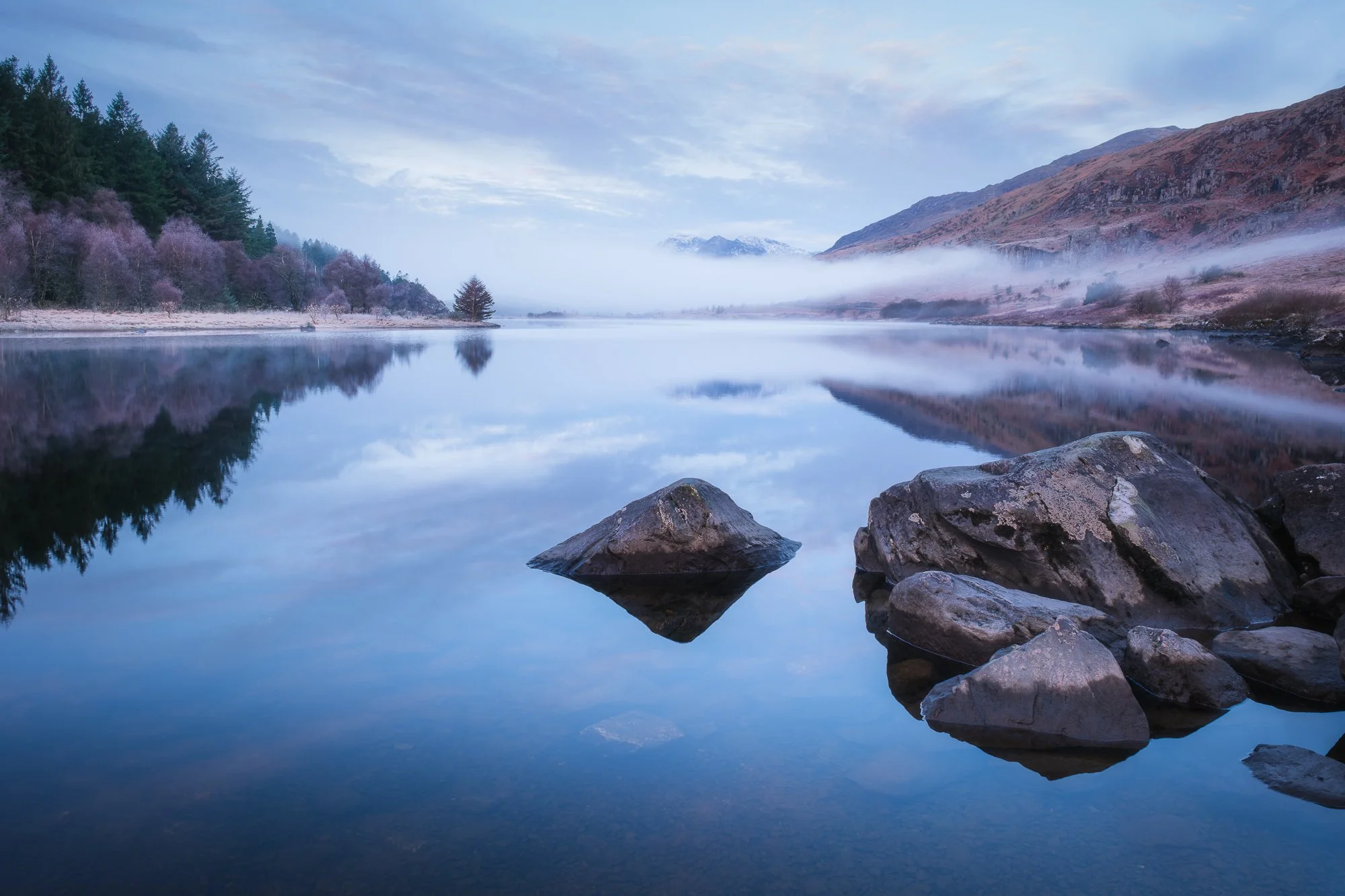
Fujifilm XT5 | XF16-55mm | 18mm | 1/4th Second | f/10 | ISO125
I wanted to photograph the wide vista but minimise the foreground and sky. One way I could achieve this is to choose a wider focal length and just crop the image into a panoramic. The issue with that approach is that the wider the focal length, the smaller the mountains will look in the frame.
What I tend to do in this situation is to create a stitched panoramic image using a longer focal length. This way, the mountains still retain their prominence, and I don’t have to crop the photo and essentially throw pixels away.
To get as much resolution as I could, I rotated the camera to a portrait orientation and zoomed in even further, pulling the mountains closer to me. Although this means I need to take more photos as I pan, the resulting image has a far higher resolution. I took the various photos while panning the camera from left to right, overlapping each one by around 50%. I made sure to start and finish the panoramic further to the left and right of the scene than I needed as this gave me more flexibility with the final crop back in post-production.

Taking multiple photos and stitching them together can be problematic if there’s movement in the scene, particularly in water as it can make them more difficult to line up. Thankfully, the water was still, and the clouds were moving slowly enough that Lightroom had no issues at all. After a creative crop, the resulting photo below is a respectable 115 megapixels and if I ever decide to print this photo, I’ll have no issues regardless of the size I want to make it.
It can be tricky to view panoramic photos properly when using a small phone screen. If you are using a phone to read this blog, try to view it on a larger screen or at least select the photo and rotate your screen to get a better view.
Fujifilm XT5 | XF50-140mm | 74mm | 1/2 Second | f/11 | ISO125 (Stitched Pano)
With the telephoto lens still attached, Snowdon made its last appearance of the morning, and with the lake still offering up these fantastic reflections, I composed a landscape-oriented photo making more of a feature of the mist and mountains in the distance.

Fujifilm XT5 | XF50-140mm | 50mm | 0.6 Seconds | f/11 | ISO125
Happy with the pre-dawn photos I’d taken, I stopped to take a break and just enjoy the scene unfolding in front of me. I was hoping some colour would appear in the sky but the very subtle hint of magenta you can see in the photo above was the best it got before thicker clouds started to roll in across the mountains. That was the last time I would see the Snowdon Horseshoe that morning.
As dawn turned to day, the sun, which was now rising over my left shoulder was lighting up the hills with a beautiful orange glow, so I grabbed the camera and made a few handheld photos of the scene. Having Snowdon visible in the background would have been the icing on the cake, but it was not to be.

Fujifilm XT5 | XF16-55mm | 20mm | 1/50th Second | f/8 | ISO125
I also took a more simplified photo of the view across the lake, removing the foreground rocks to give the image more of a mirror-like look. The subtle ripples you can see in the water “ruining” my perfect reflection was not due to wind, but the effects of some early morning swimmers over to the left of me.
Of course, I jest about it ruining my photo, as I appreciate the lake is there for us all to share. I waited a while, but more swimmers started to arrive, this time to the right of me, so, all I could do was try to take the best photo possible at the time. I still really like the results.
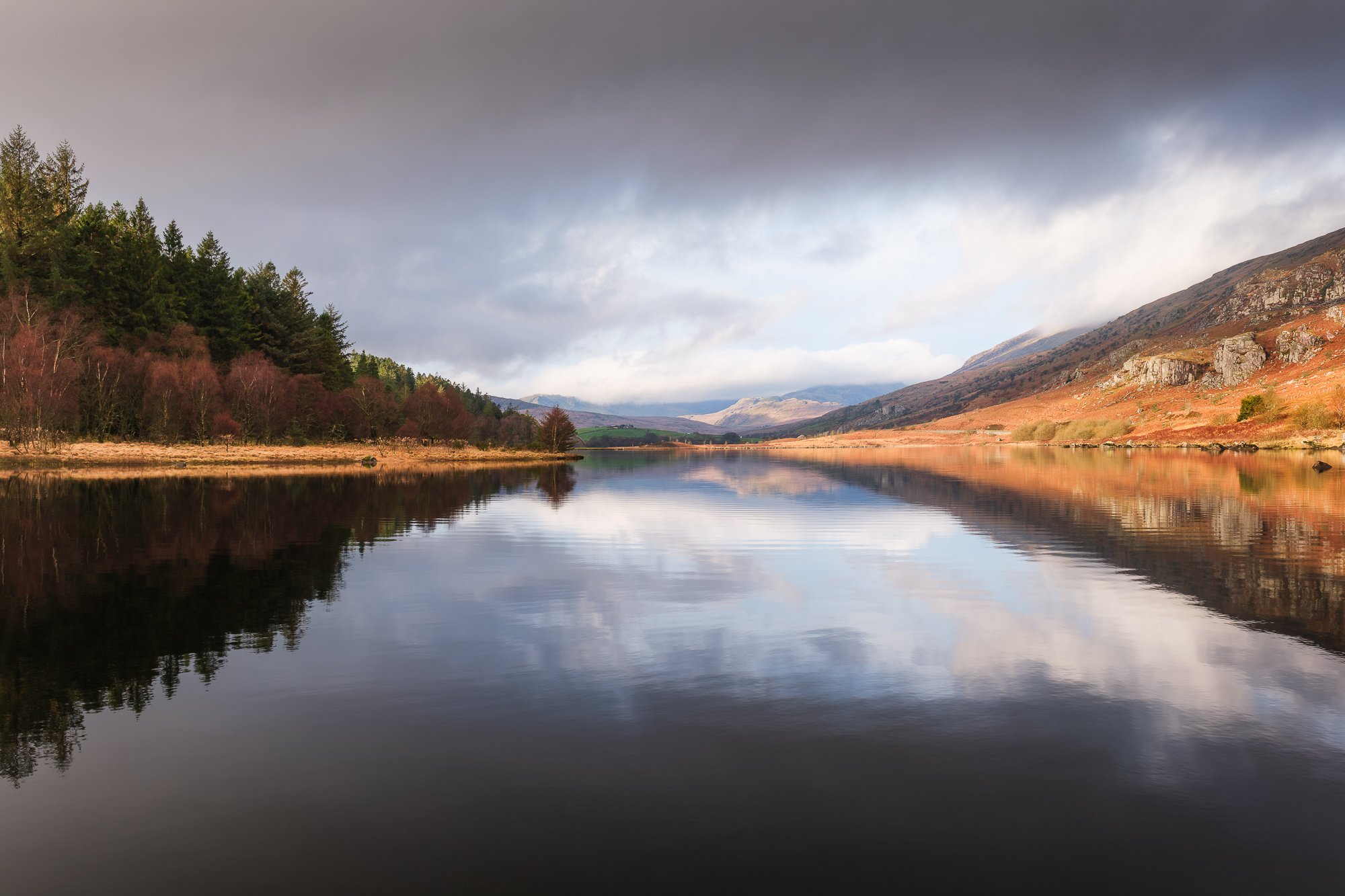
Fujifilm XT5 | XF16-55mm | 19mm | 1/50th Second | f/8 | ISO125
Getting on for mid-morning, the best of the light was gone and with only a few hours left before driving home, I went back to the Ogwen Valley as there were still a couple of photos that, for one reason or another, I hadn’t yet managed to take.
Photographing Cwm Idwal and the Ogwen Falls
Once again, I parked further up the road, beside Llyn Ogwen and walked up to Llyn Idwal as I wanted to take a photo of Cwm Idwal’s fantastic natural amphitheatre. It was a composition I had taken the year before and although I was happy with it, the lack of a wide-angle lens meant that I couldn’t include enough foreground or leave enough sky above the mountains.
Next to the bridge where Llyn Idwal feeds into Afon Idwal, I placed my tripod into the shallow water and mounted my camera about a foot above the surface. I used two of my Kase filters for this photo. The first was the CPL filter which helped to remove some of the glare from the water and wet rocks. The second was my three-stop ND filter which enabled me to set a shutter speed of 1/20th of a second and smooth the water a little as it rolled over the rocks in front of me.
Right in the middle of the image, at the top of the ridge is a big crack in the rock called Twll Du (Black Hole), also known as the Devil’s Kitchen. It’s called the Devil’s Kitchen because water flows into the crack at speed and the spray it causes appears like a plume of steam rising from within the rocks. It’s said, when steam can be seen rising from the chimney, the Devil is cooking.

Fujifilm XT5 | XF10-24mm | 12mm | 1/20th Second | f/11 | ISO125
While sitting on a rock, having a snack, I decided to send the DJI Mini 3 Pro drone up to see what the view looked like from high above Llyn Idwal. The clouds continued to hug the top of the peaks with the sun breaking through from time to time. I flew towards the Devil’s Kitchen at the back of the lake, turned the drone around and framed up this familiar view of Pen yr Ole Wen with its peak lost in a layer of clouds.
While keeping half an eye on the drone’s battery levels, I waited for what seemed like an age for the clouds to become a little more central above the mountain and once in position, I was able to take this photo of Llyn Idwal and Pen yr Ole Wen across the valley.
With the drone safely landed, I made my way down to the Ogwen Falls to take my last photo of the trip.

DJI Mini 3 Pro | 24mm (effective) | 1/6,400th Second | f/1.7 | ISO100
Dark clouds over Tryfan at the Ogwen Falls
This is a view that escaped me when I visited a year before. On that day, the skies were blue, and the light was too strong to make a photo I was happy with, so, with another opportunity to photograph the scene, I scrambled back down to take in this popular view of the Ogwen Falls with a part covered Tryfan lurking menacingly the background.
The good news is that the sky wasn’t blue, and I had some moody clouds to use to add a touch of drama, but as good as those clouds were, unfortunately, they were also blocking Tryfan’s recognisable peak. Not to be deterred, up went the tripod and out came the camera for the very last time of the trip. Once again, I used the CPL and ND filters for this photo for the same reasons as before and then I waited in the hope that Tryfan would make an appearance.
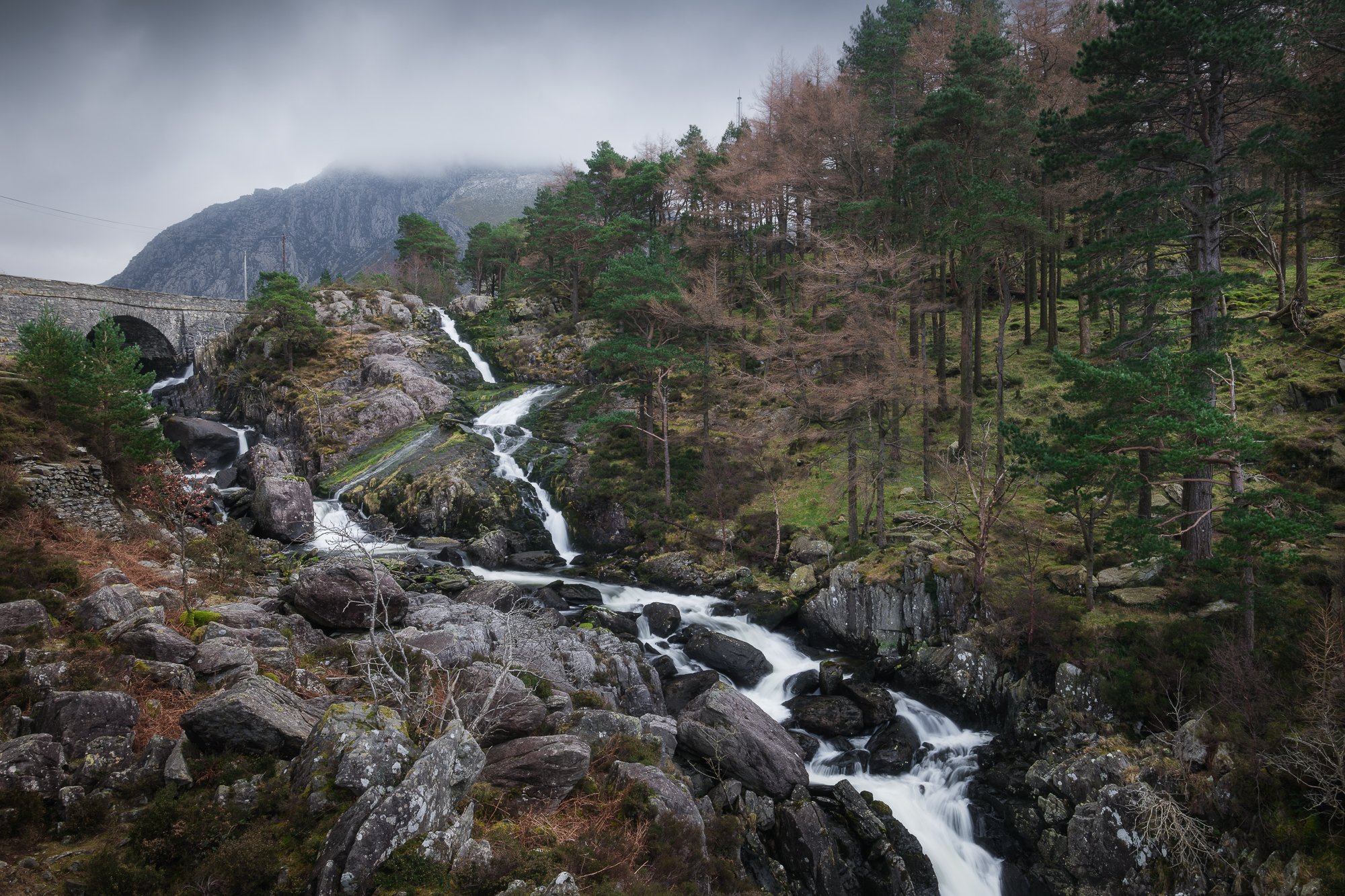
Fujifilm XT5 | XF10-24mm | 16mm | 1/5th Second | f/8 | ISO125
All I needed was a second or two to react and take the photo, but it was not to be. I even sent my drone up while I waited but still, the clouds wouldn’t release their firm grip of Tryfan’s peak.
Even with a lack of interesting light, I’m still happy with both the photos I took at this location as the dark clouds provided some contrast and mood I could work with. Tryfan’s summit never did make an appearance and after around an hour, it was time to pack up and head home.

DJI Mini 3 Pro | 24mm (effective) | 1/1,250th Second | f/1.7 | ISO100
As I embarked on the 5-hour drive home, I reflected on how I thought the trip went and what I might do differently next time. I was feeling optimistic about some of the photos I took, and it seems that optimism was well placed, as along with quite a few photos I was happy to share on this blog, I did manage to take one or two photos I especially like and may even make it into my portfolio. I’ll leave you to guess what ones they are.
When I return (and I will return), I plan to visit in Autumn as I want to capture a bit more of the Snowdonia woodland in my photos and maybe visit a few of the beautiful waterfalls found in the national park. I do have a family trip to Snowdonia planned for the end of May 2024, but it will be a busy week and I don’t expect to get too many landscape photos. I also plan to travel lighter on the next trip. I got away with it this time as I didn’t summit any mountains, but next time I plan to climb even higher to take in some new views to photograph. At the time of writing, I have already added a 16-80mm lens to my kit which means I can carry just the three, lighter lenses which will help me when I take on those more strenuous hikes.
I know these longer-form posts are not for everyone, so thanks for sticking with it and reaching the end of this rather long two-part blog post. I’m motivated to share more from my landscape photography trips, so stay tuned for more on-location blog posts soon.
Until next time,
Trevor.
If you enjoy these longer, on-location articles, I’ve posted a few more from some of my previous trips to Wales below. All the On-Location blog posts I’ve ever written can be found here.


On Location Photographing Snowdonia Part One
The first of two instalments of an on-location article chronicling my recent landscape photography trip to Snowdonia.
Snowdonia, where rugged peaks pierce the heavens and mist-clad valleys cradle the tranquil lakes as they reflect the ever-changing drama of the sky above.
Situated in North Wales, this breathtaking national park enchants both photographers and wanderers alike. Join me as I recount my recent trip to photograph the awe-inspiring beauty of this stunning landscape.
Back in January 2023, I made my first dedicated photography trip to Snowdonia. I spent a wonderful two days photographing the mountainous landscape and had the good fortune of timing my visit while there was a blanket of snow across the higher ground. After just a short 48 hours, I could see why this location was loved by so many. The views are simply spectacular and feeling incredibly inspired by the landscape as I drove home from that trip in 2023, I knew I would be back again soon enough.
Fast forward just over a year to February 2024 and with my bag packed and a tank full of fuel, I was off once again to immerse myself in this beautifully rugged landscape, exploring the mountains with my camera and with hope, coming away with a few keepers.
With so many photos to share, I split them into two posts for easier viewing, and if you can, I recommend reading them on a larger screen to get the full benefit of the photos I’ve included. This is part one and you'll find the link to part two at the end of this post.
With the UK experiencing such a mild winter, with plenty of wind and rain, I knew I wouldn’t be lucky enough to get the wintry conditions I had the previous year, but that didn’t bother me at all. Being someone who likes a sky full of clouds and soft, defused light; my biggest fear was having two days of clear blue skies with harsh directional light across the landscape. Those more predictable conditions are perfect to hike in but certainly not for my style of photography. As you will see from the photos I’ve shared below, the weather gods were again on my side.
If you’re interested in looking at some of the photos I took on my previous trip, you can jump into that blog by selecting the thumbnail here.

A quick note about the photography gear I took with me. Overall, it was similar to what was in my camera bag back in January 2023. I still have the same Fujifilm XT5 camera, DJI Mini 3 Pro drone, Kase magnetic filters and Benro Mach3 TMA37AL tripod with the Gd3Wh geared head.
The only changes I made were the additional lenses I took this time. On my last visit, the only regrets I had in terms of the gear I took was not being able to go wider than 16mm when trying to include a stronger foreground while still leaving plenty of space in the sky above the mountains and not being able to zoom in more, extracting extra detail when photographing the distant peaks. So, alongside my XF16-55mm standard zoom and 50-140mm telephoto, I added the XF10-24 wide angle and the XF70-300mm telephoto giving me a focal range of 10mm to 300mm or in full frame terms, 16 to 450mm. The obvious downside here is the extra weight in the bag but even with all this kit in the camera bag, it was still manageable even on the more strenuous hikes.

If you want to read more about the kit I use for my landscape photography, check out my latest camera gear blog post here: My Camera Gear for Landscape Photography in 2024
Landscape photography in the Ogwen Valley
I love to explore the Ogwen Valley, and this was the first of two visits I made during the 48 hours I spent in Snowdonia. Featuring so many stunning views in a relatively small area with opportunities for both leisurely walks and strenuous hikes on offer, it's no wonder the area is so popular.
Pen yr Ole Wen from above Llyn Idwal

Arriving after my 5-hour drive from southeast England, I headed straight for the Ogwen Valley and knowing how busy the car park could get at the Ogwen Cottage, I decided to walk the extra 5-10 minutes and parked further along Llyn Ogwen at this car park where there are typically more free spaces. I grabbed a quick coffee at the cafe and started to make my way up towards Cwm Idwal.
I’m the kind of photographer who works better after a little warming up and I will often try to take a photo or two early on a trip as it helps me get into the zone faster and see potential compositions more easily.
So, after walking just a few minutes up the trail and with some moody skies above Y Garn, out came the camera to photograph the cascades from the footbridge across Afon Idwal.
Along with the camera and lens, I used two filters to take this photo, the first being my circular polariser (CPL). Although there were some dark clouds above the peaks, it was still quite bright overhead as the sun was coming in and out to the left of the frame and using the CPL helped me by removing some of the reflective light from the water and rocks.

Fujifilm XT5 | XF10-24mm | 15mm | 1/13th Second | f/8 | ISO125
Secondly, I used a 3-stop neutral density (ND) filter which allowed me to slow the shutter speed just enough to capture the movement and get the effect I wanted in the flowing water.
I’m happy with how the photo turned out and although I think I prefer this composition, I think the version I took with snow-capped peaks in the background a year before is the better of the two.
Following the trail that runs uphill alongside Afon Idwal for 10 or 15 minutes, I arrived at the banks of Llyn Idwal. From the north side of the lake, you can take in the breathtaking view of Cwm Idwal’s natural amphitheatre (you’ll see a photo of this in part two, it’s quite stunning).
With the sun to the south, behind the high ridge, Cwm Idwal was in the shade and to the north across the valley, I could see the winter light hitting the face of Pen yr Ole Wen. With the clouds kissing the peak as they passed by, I decided to head around to the south side of the lake and take a photo from there.
As I reached the other side of Llyn Idwal, I first took the lower path and found this composition below using some of the exposed jagged rocks to provide some interest in the foreground. I composed the frame so that the lake would snake in from the right, leading towards Pen yr Ole Wen and at the same time, offering some balance to the dominant rock features on the left. During this time, the clouds had started to break up a little behind me and I quite liked the dappled light hitting Pen yr Ole Wen in the distance.
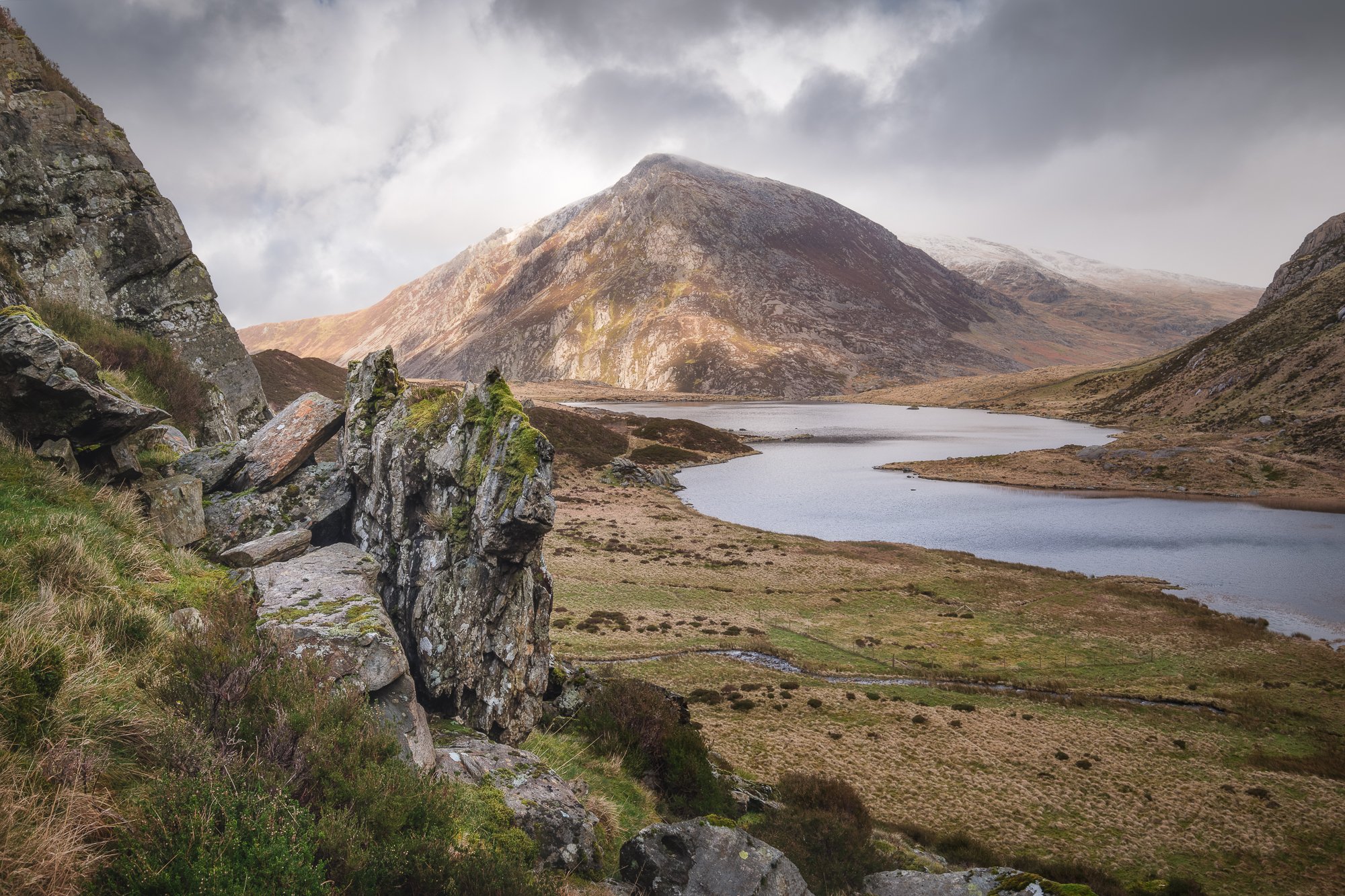
Fujifilm XT5 | XF10-24mm | 17mm | 1/200th Second | f/8 | ISO125
At this stage, I was still only a few metres higher than the lake and being curious to see how the view might look from a more elevated position, I climbed the upper path towards the crack in the rocks called the Devil’s Kitchen or Twll Du (black hole) as its also known. From this spot, around 550 metres up, I could include the entire lake and the slopes on either side of the scene helped to balance the composition and frame Pen yr Ole Wen which I once again placed in the centre of the image.
As the clouds rolled in from the left-hand side, I took a few photos, some with dappled light on the mountain, but of those I took, I like this photo below the most. The cooler tones are muted, and the clouds have drama but without being too distracting. I also like how the low, misty clouds on the left hug the side of the mountain as they travel east through the valley.

Fujifilm XT5 | XF10-24mm | 21mm | 1/30th Second | f/8 | ISO125
The classic view of Tryfan from beside Afon Lloer
I get it, this view of Tryfan is probably one of the most photographed views in the Ogwen Valley and far from original, but that doesn’t matter to me in the slightest. Having tried and failed to get a photo of Tryfan I really like for a few years now, nothing was going to stop me from having another go.
One of the many things I’ve learned about photographing Snowdonia is that on a cloudy day, the weather can change significantly from one minute to the next, making the task of capturing some sunset colour even harder to predict. While heading down from Cwm Idwal I noticed the clouds were starting to thin, meaning there was a small chance of catching a sunset. Buoyed by the thought of getting that photo I’ve wanted for so long, I set off up the other side of the valley in a bid to be in the right place at the right time to get my shot of the mighty Tryfan.
There were two locations I wanted to take a photo from, both shown below. I made my way to the higher spot first, which features this old stone wall and a wooden stile. I absolutely love this composition. There is a similar, seemingly more popular composition on the other side of the stream, but I find the wall cuts across the scene more abruptly, appearing to slice the photo in half whereas, compared to this scene, the wall heads off into the distance but importantly disappears within the frame rather than leading the viewer off the edge of the photo.
As you can see, the cloud had rolled back in as I was making my way up the hill, so a sunset was looking less and less likely by the minute. I didn’t mind though; as I love the drama in the sky and although some evening light would have been great, I would take these moody clouds over a predominantly clear sky every single time.
This was hands-down my favourite photo I took that day.

Fujifilm XT5 | XF10-24mm | 11mm | 1/15th Second | f/9 | ISO125
Feeling pretty happy with the photo I’d just taken, I made my way back down the hill, stopping about halfway down next to this small waterfall to make my final photo of the day. It’s another composition I’d love to photograph with some sunset light in the sky but the best I had was a slight thinning of the cloud you can see on the right side of the image.
With the light fading fast, I hurriedly set the camera up and while experimenting with various shutter speeds, took multiple photos of this composition. After looking at the photos properly later in Lightroom, I settled on this image below taken at 1/8th second as the water was moving incredibly fast and it captures that energy perfectly.

Fujifilm XT5 | XF10-24mm | 10mm | 1/8th Second | f/8 | ISO125
As I mentioned before the weather can change quickly in the mountains, so, being somewhat overly optimistic, I hung around for a short while after sunset just in case a gap in the clouds appeared. Alas, it was not to be, so I packed up my gear and walked back to the car.
Photographing the Nant Gwynant Valley
Waking up the next morning, I set off before sunrise towards the Nant Gwynant Valley, a location I’d tried and failed to photograph the year before. Parking my car here, instead of heading to the usual roadside viewpoint most people go to, I crossed the road, went through the gate and climbed around 300m to a spot I believe offers a much better view of the lakes and valley below.

Fujifilm XT5 | XF70-300mm | 70mm | 1/25th Second | f/9 | ISO125
I arrived on location around 30 minutes before sunrise and as the landscape started to appear in front of me, I got a slight feeling of déjà vu and not in a good way! Rain was in the air; visibility was poor and there was no sign of any useful light appearing. Part of me wondered if I had wasted another sunrise up this hill.
With the daylight starting to brighten up the snow-capped Snowdon range across the valley, I mounted the 70-300mm telephoto lens for the first time on this trip and took some photos of the peaks as they momentarily appeared between gaps in the low-lying clouds. Being drawn to the textures created by the snow and rocks, the two below with a monochromatic pencil sketch look are my favourites from the set.
Fujifilm XT5 | XF70-300mm | 300mm | 1/20th Second | f/9 | ISO125
Fujifilm XT5 | XF70-300mm | 198mm | 1/30th Second | f/9 | ISO125
Turning my attention back to the view down the valley, Llyn Gwynant and the area around it was still looking a bit hazy and subdued so I decided it was time to get the drone up and fly it around the valley to see what the view looked like from up high.
Fujifilm XT5 | XF16-55mm | 39mm | 1/60th Second | f/7.1 | ISO125
DJI Mini 3 Pro | 24mm (effective) | 1/1,250th Second | f/1.7 | ISO100
While flying the drone and enjoying the views, the sun started to rise higher in the sky, illuminating the far side of the valley, and making for some interesting contrast between the light and shadow areas. Of the handful of photos I took while flying the drone, the two images above and below are those I kept.
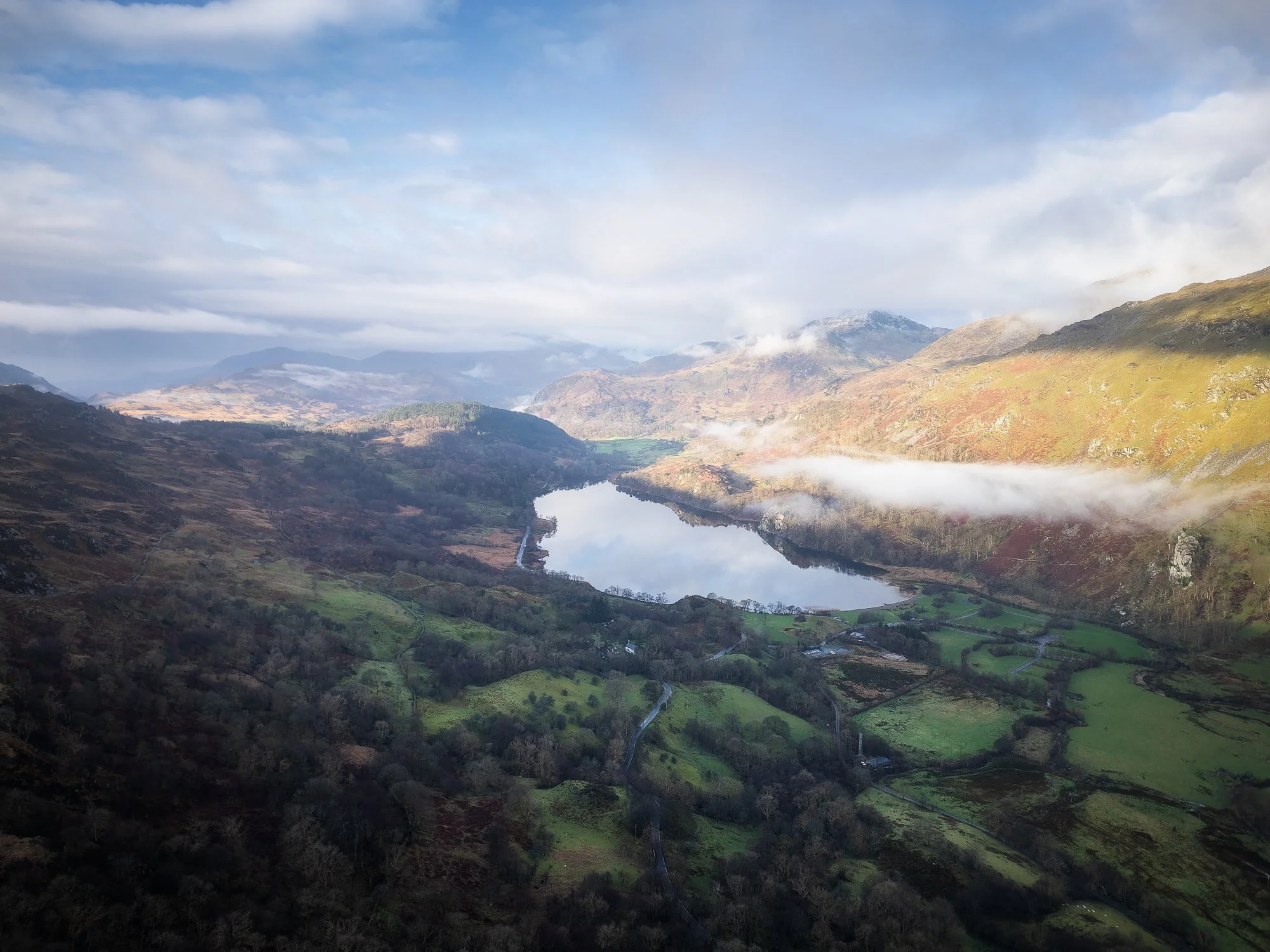
DJI Mini 3 Pro | 24mm (effective) | 1/2,500th Second | f/1.7 | ISO100
With the drone still high above me, I noticed the sun was lighting up the far side of the valley. Llyn Gwynant was like a mirror and some low-lying clouds were working their way up the valley. Although there was still plenty of haze in the air, I was sure there was a photo to be had here.
As I landed the drone, the low-lying clouds were starting to surround the lake and with more of the scene basking in that glorious light, I managed to take my favourite photo of the morning. If I were being super picky, some of the higher peaks would be visible and not blocked by the clouds but I couldn’t wait for them to appear as the clouds around the lake were moving through the scene quickly and would have soon been out of the frame.

Fujifilm XT5 | XF16-55mm | 40mm | 1/125th Second | f/7.1 | ISO125
Photographing reflections at Llyn Gwynant
While standing high above Llyn Gwynant, I couldn’t help but notice the mirror-like reflections on its surface. With my photo of the lake from this vantage point in the bag, I made my way back down the hill to the car and drove to the banks of Llyn Gwynant hoping to photograph some of those gorgeous reflections.
Thankfully, the winds held off for a while longer, allowing me the time to get into position beside the water and from this spot, the reflections looked even better! I was over the moon with the photos I took and have shared two of them below. With a bit more drama in the sky and the top of (I think) Bylchau Terfyn subtly peeking through the clouds on the right, I prefer the first photo.

Fujifilm XT5 | XF16-55mm | 29mm | 1/60th Second | f/10 | ISO125
Fujifilm XT5 | XF16-55mm | 21mm | 1/50th Second | f/10 | ISO125
Once I was finished taking photos with the Fujifilm XT5, I sent the drone up again to see how the lake looked from the air. Thicker clouds had now rolled in over to the south, but as the sun was still casting its light over the scene from the east, it created a nice contrast between the darker clouds and the illuminated landscape.

DJI Mini 3 Pro | 24mm (effective) | 1/5000th Second | f/1.7 | ISO100
The Snowdon Range from across Lynnau Mymbyr
By now, it was getting close to midday and with the sun out, high up in the sky, these were not normally conditions I liked to photograph in. I packed up my gear and set off to find a place to grab a coffee. I didn’t make it far. As I drove towards Capel Curig, I parked up here to spend a few minutes beside Lynnau Mymbyr. I wasn’t particularly hopeful and only intended to stop momentarily to take in the view of the Snowdon Range from across the lake, but as I arrived, I got the feeling there might be a photo or two to be had here after all.
The wind had picked up just a bit, but in between gusts, the ripples settled down and the reflections on the lake were revealed. I started with the XF50-140 telephoto lens and took the slightly wider landscape image shown below. The clouds were hugging the peaks in the distance but above me, there were clear blue skies, and with the light a bit strong for my liking, I took this photo intending to illustrate the view I was witnessing rather than to bag a portfolio-worthy image.
That being said, I do like the photo. The reflections aren’t perfect, but still pretty good and I particularly like how the white clouds mimic the shapes of the mountains underneath. I’m not sure if that’s just a coincidence or if it’s the result of the clouds passing over, following the shape of the mountains.

Fujifilm XT5 | XF50-140mm | 61mm | 1/40th Second | f/11 | ISO125
Zooming into the landscape a little more, I wanted to make more of a feature of the Snowdon peaks and reflections in the water, while at the same time removing some of that blue sky from the frame.
There’s quite a lot going on in this composition, with the diagonal lines, the symmetry created by the reflections and the central positioning of the mountain peaks.
While composing the image, I felt a square crop worked best as it helped balance these elements better. With a wider, landscape aspect ratio, it was too heavy on the right of the frame and going with the square helped me to eliminate parts of the scene I either found distracting or didn’t add anything to the overall image.
Given the time of day this photo was taken, I’m surprised how much I like it, as I wouldn’t typically consider getting the camera out in the middle of the day with the sun so high in the sky, casting such strong light on the landscape. I guess it proves that if you keep an open mind, there is always an opportunity for a photo, regardless of the conditions.
Fujifilm XT5 | XF50-140mm | 80mm | 1/40th Second | f/11 | ISO125
Photographing Yr Wyddfa
With Snowdon’s peak appearing now and then from behind the clouds, I mounted my 70-300mm lens onto the camera and zoomed right in to get a detailed photo of this much-loved mountain. Having to punch through so much atmosphere between my camera and subject, there was a lot of haze and the scene lacked clarity, so I used my CPL filter which helped bring some of the definition back.
I waited patiently, ready to press the shutter the moment Snowdon reappeared into view and after a few minutes, I got a brief glimpse and fired the shutter. As fast as Snowdon revealed itself, it was gone again and with so much cloud lingering above the mountains, there was no telling when it might reappear. No matter, I had the photo I wanted and after editing it back in Lightroom, It’s now one of my favourite photos of the entire trip.

Fujifilm XT5 | XF70-300mm | 300mm | 1/100th Second | f/11 | ISO125
There is so much detail in the photo. The XF70-300mm is not considered one of Fujifilm’s high-end lenses but it certainly delivered for me. The photo was nice and sharp and to get a real sense of the detail I was able to capture, I’ve also posted a cropped version of the same image below. The original is around 40 megapixels, and the one below has been cropped to around 6 megapixels.

Fujifilm XT5 | XF70-300mm | 300mm (significant crop) | 1/100th Second | f/11 | ISO125
How cool does that look? The detail is amazing! You can see the tiny figures of people who have climbed Snowdon and are now lining up to have their moment standing on its famous summit. It is bonkers what I can photograph with a range of 10mm to 300mm on the Fujifilm’s cropped sensor.
That’s it for part one of this on-location blog post. You can read part two by clicking on the thumbnail here to read how I got on during the second half of my trip.


On Location | Photographing a Wintry Snowdonia
In January 2023, I took a trip to Snowdonia to spend 48 hours photographing this stunning, snow-covered landscape, from epic sunrises to aerial drone panoramas.
Ever since taking up landscape photos, I’ve been fascinated by the Welsh landscape. From the beautiful waterfall country in the south to the rugged, mountainous terrain in the north, but as I am based down in the Southeast of England, I’m a good 3 hour’s drive from the Welsh border and even further from the likes of the Brecon Beacons or Snowdonia in the north. This means heading there for a sunrise shoot or even just for an entire day is tricky as the round trip alone would take half a day. To make a trip worthwhile, it really needs to be at least 24 hours and even better, 48.
Starting off in The Brecon Beacons in 2021, I’ve since made a couple of trips to photograph the amazing waterfalls on offer but in January this year (2023), I drove further north to spend 48 hours photographing the more dramatic landscape in Snowdonia.
Although I had a few locations in mind, I wanted to focus most of my attention in and around the Ogwen Valley, so I booked an inexpensive hotel close by and set off for Wales.

With some inevitable hills to climb, I needed to strike a balance between having the right gear with me and keeping the weight manageable, I packed my Fujifilm XT5 body and two lenses, the 16-55mm standard zoom and 50-140mm telephoto.
With the scenery on offer, there was no way I would be travelling without the drone, so in the bag that went along with my Kase filters, batteries, memory cards and head torch.
Although a little on the heavy side, I took my Benro tripod and geared head as I wasn’t sure how windy it might get up on the mountains and wanted to ensure I had a good, stable tripod to work with.
For more detail about what I carry in my camera bag, check out my latest “What’s in my camera bag?” blog post.
Heading off first thing on Friday and arriving in the national park later that afternoon to a beautiful snowy landscape and clear blue skies, I spent the first few hours getting to know the area around the Ogwen Valley, scouting a few locations for when the light would hopefully improve. Typically, when in an environment I know well and the light doesn’t lend itself to photographing the wider landscape I will focus my attention on smaller scenes and take more intimate landscape photos, but when in a new landscape, especially those as beautiful and dramatic as this, I often get distracted and just end up wandering around in awe of my surroundings.
Photographing Tryfan from across the Ogwen Valley
Being the middle of winter, the sun started to dip quite quickly so I made my way up to the first location I had planned, which was this classic view of Tryfan and Llyn Ogwen. Back in June 2022, I spent a week in Snowdonia with some family and friends and while there, managed to fit in a couple of landscape photography shoots. One of the locations I went to back then was here, to photograph the same view of Tryfan from across the valley.

Fujifilm XT5 | XF16-55mm F2.8 | 16mm | 1/5th Second | f/16 | ISO125
There is a popular composition up on the edge of Pen yr Ole Wen which features a stone wall and stile. The one I’ve seen plenty of is to the right of the stream (as you’re looking back down the slope) but in that composition, the wall seems to cut a horizontal line straight through the middle of the scene which I find quite distracting. Instead, along the same wall, on the other side of Afon Lloer, there is another Stile, but this time the wall comes into the frame from the left and leads the eye a little further into the scene and at this time of year, straight towards the setting sun.
It took a bit longer than I planned to climb as the higher I went, the deeper the snow got so I had to take it slow, being careful not to lose my foot in a snow-covered gap between the rocks. When I did finally arrive, the sky hadn’t improved at all, so I positioned my camera ready to capture the sun just as it dipped behind the horizon and managed to photograph the picture above featuring a small sunburst before the sun disappeared for good, leaving a beautiful landscape but a rather uninteresting sky.

Fujifilm XT5 | XF16-55mm F2.8 | 16mm | 1/60th Second | f/9 | ISO125
Happy with the sunburst image at least and with the sun now behind Cwm Idwal across the valley, I decided to make my way down the mountain, following Afon Lloer to the same spot I photographed back in June. I like this position on the hillside as I’m able to use the small waterfall in the foreground to help build a stronger composition and although the partially snow-covered ground made for a messier landscape than I would have liked, there was still a shot to be had. Being careful not to slip into the water, I set my tripod as low as I could and framed up a composition.
By this time, some high-level clouds had drifted in and although the sun had already set, there was a lovely post-sunset glow emanating from behind Cwm Idwal, so with the light levels dropping fast and not wanting to miss the opportunity, I clicked the shutter and bagged this photo below.
This is the first of two times I found my 16-55mm lens just a bit tight and could have done with a slightly wider focal length to include a bit more foreground and a little more sky but overall, I’m pleased with the picture I took.
With the best of the light now gone, I made my way back down the hill to the car and headed for my hotel.

Fujifilm XT5 | XF16-55mm F2.8 | 16mm | 1/4 Second | f/5 | ISO125
Photographing Snowdon from Lynnau Mymbyr
Fast forward to the next morning and my only full day of the trip, I decided to drive the short distance to Lynnau Mymbyr to photograph the well-known view of Snowdon’s horseshoe from across the lake. With very little wind and the potential for nice light, my hope was for a calm lake with plenty of reflections to play with but as it got lighter, it became clear that the lake was completely frozen over. This may not have been what I had hoped for but at least the surface was still, meaning there were at least some reflections to play with.
As the blue hour started to creep in, the cool tones that draped across the landscape were simply stunning and the snow-covered peaks were illuminated by the early light, helping them to stand out in the distance. Taking a few minutes to find a composition, I found this spot here behind some rocks which I could use to provide some interest in the foreground and with the tripod resting on top of the lake’s frozen surface, it was time to take my first picture of the day.

Fujifilm XT5 | XF16-55mm F2.8 | 18mm | 2 Seconds | f/8 | ISO125
Starting with the wider composition above and using the rocks to build a stronger composition, I tried to create as much symmetry as I could using the banks on either side and adjusting the height of the tripod to allow plenty of space between the layers of rocks, reflections and background but still staying as close to those rocks as I could, I managed to take one of my favourite photos from the trip.
To make a real feature of Snowdon’s horseshoe, still using the 16-55mm lens, I zoomed in to around 42mm and with a 2:1 crop, I took this blue hour pano of the frozen lake and snowy mountains. The great thing about my new Fujifilm XT5 camera is that I now have 40MP to play with and even after cropping this image to a 2:1 ratio, the resulting image is still 28MP. That’s plenty of resolution for creating reasonably large prints and still more than my old 24MP XT2.
Fujifilm XT5 | XF16-55mm F2.8 | 43mm | 1.3 Seconds | f/8 | ISO125
As the blue hour faded and the pre-sunrise light started to get more intense, the sky became awash with these wonderful pastel pink colours. Being from the Southeast of England, our landscapes are nowhere near as impressive as those in Snowdonia, so for me, I was simply in awe of the scene and the conditions I was witnessing.
Like with my first blue hour picture above, I switched back to a wider focal length and captured the image below and all its wonderful pastel pink colours reflecting from the lake’s frozen surface.

Fujifilm XT5 | XF16-55mm F2.8 | 17mm | 1/3rd Second | f/8 | ISO125
For the picture below, I decided to make it a multi-image panoramic. As the vivid pinks started to fade, I switched to the 50-140mm telephoto lens and zoomed in to around 70mm. With my tripod and camera completely level, I swept the camera from left to right taking pictures along the way which I stitched together later in Lightroom to produce this close-up 3:1 panoramic of the Snowdon peaks basking in the warm sunrise light.

Fujifilm XT5 | XF50-140mm F2.8 | 72mm | 1/15th Second | f/8 | ISO125
With the 50-140mm lens still attached, for my final picture of the morning, I zoomed in to 106mm to pick out a much tighter wintry composition of Snowdon’s snow-covered peak (the one on the left). with the beautiful pink clouds above. What I like about this image (apart from the light and colour), is the repeating horizontal and diagonal lines you can see through the scene which provide some interesting repeating patterns while adding a sense of depth at the same time.
After the best of the light was gone, off I went to my next location.

Fujifilm XT5 | XF50-140mm F2.8 | 106mm | 1/13th Second | f/8 | ISO125
Photographing the Ogwen Valley with my drone
After a fantastic and successful morning photographing Snowdon, I headed back to the Ogwen Valley. By the time I had found somewhere to park and refuelled with some food and a coffee, it was getting close to midday. Although I had flown my drone a little that morning, I didn’t manage to take any good photos with it, so I sent it up again to see what I could see.
I parked just west of Llyn Ogwen, along a small country road and flew the drone up and around this area of the valley.
With Tryfan over in the background, I focused my attention on the contrasting landscape with snow-covered hills to the right and a greener, exposed landscape to the left. On top of this, there were sunlit areas with dappled light across the landscape adding more interest to the scene.
I admit, the sky wasn’t great, but given the time of day, I’m still pretty happy with how they look.

DJI Mavic Mini 3 | 24mm (effective) | 1/4,000th Second | f/1.7 | ISO100
I spent 30 minutes to an hour flying around the valley and from this flight, the picture below is probably my favourite. I like that there is more of the snowy landscape in the frame and the transition in the foreground where the snow stops, giving way to the ground underneath. This transition creates a subtle lead-in line towards Llyn Ogwen and further through the valley to Tryfan.
On the right-hand side of the picture, you can see the reflective surface of Llyn Idwal and that’s where I’m heading next.

DJI Mavic Mini 3 | 24mm (effective) | 1/6,400th Second | f/1.7 | ISO100

DJI Mavic Mini 3 | 24mm (effective) | 1/1,000th Second | f/1.7 | ISO100

DJI Mavic Mini 3 | 24mm (effective) | 1/6,400th Second | f/1.7 | ISO100
By this point, it was mid-afternoon and with sunset around 4:30-5pm, I started to slowly make my way to my final spot of the day which was part way up Y Garn. To get there, I first needed to get to Llyn Idwal. Once there, I spent a while looking for some interesting compositions of the lake but there was a small problem. Although the scenery was absolutely stunning, the frozen lake had lots of broken ice spread across its surface. I assume from people throwing it on to see if they could break the surface. This meant any attempt to capture the clean reflections in the ice from the edge of the lake would be thwarted by the inclusion of lots of broken pieces of ice. So, after trying and failing to take a picture from ground level, up went the Mini 3 Pro once again to see what I could see from the air.

DJI Mavic Mini 3 | 24mm (effective) | 1/6,400th Second | f/1.7 | ISO100
While flying above Llyn Idwal, I took a few pictures, including these two panoramas. The first (above) was taken from just a few feet above the lake, away from the banks and the messy ice, and by keeping the drone low, I could make the most of those fantastic reflections across the lake’s icy surface. Without the drone, this shot would have been impossible, so this alone made the inclusion of it in my bag 100% worthwhile.
The second pano (below) was taken from much higher and further back from Llyn Idwal to get more of the scene in the frame. I wanted to capture the contrast between the dark water and the brighter, snow-covered scenery. While processing the image, I did consider cropping out the green valley floor on the right, but I like the added interest and with the mountain range falling away towards the right-hand side, the colour contrast adds a touch of visual weight and balance.
For both drone panoramic photos, I rotated the DJI’s camera to a vertical orientation to get more foreground and sky in the frame. I then swept the camera from left to right, turning the drone on its axis and taking overlapping images as I went. I simply stitched the images together later in Lightroom.

DJI Mavic Mini 3 | 24mm (effective) | 1/8,00th Second | f/1.7 | ISO100
Photographing the view from Y Garn
Finishing up with the drone, I carried on past Llyn Idwal and part way up Y Garn. Although I had appropriate clothing on to photograph in the snowy mountains, I didn’t have hiking sticks or shoe grips and due to the conditions, such as hardened snow and Ice, I decided not to push my luck too much and climbed only part way up, stopping just before the incline became too slippery for spikeless walking boots. I wasn’t overly concerned about not climbing higher because my main intention was to capture this panoramic view of Llyn Idwal and Llyn Ogwen down in the valley.
Once high enough, I found a useful plateau to shoot from. With it getting late on this midwinter’s day, I knew this would be my last opportunity to take photos so with plenty of layers on I settled in for the hour or so I would be up there.

Fujifilm XT5 | XF16-55mm F2.8 | 22mm | 1/125th Second | f/8 | ISO125
The picture above was the first of two panoramic images I took of this wide, wintry vista which features both Llyn Idwal on the right and Llyn Ogwen further down the valley. The mountains in view start from the base of Pen yr Ole Wen on the far left, the mighty Tryfan across the valley nearer the middle of the frame and moving right you have Glyder Fach, Castell y Gwynt and Glyder Fawr and the Devil’s Kitchen just out of view.
With a perfectly level tripod, I took this pano by mounting my camera vertically and sweeping it from right to left, overlapping each image by around 30-40% to make sure I had enough overlap to stitch easily later in Lightroom. This final image is around 140MP and although you can’t appreciate this fully when viewing the image on the screen, the amount of detail as you zoom in is quite astonishing.
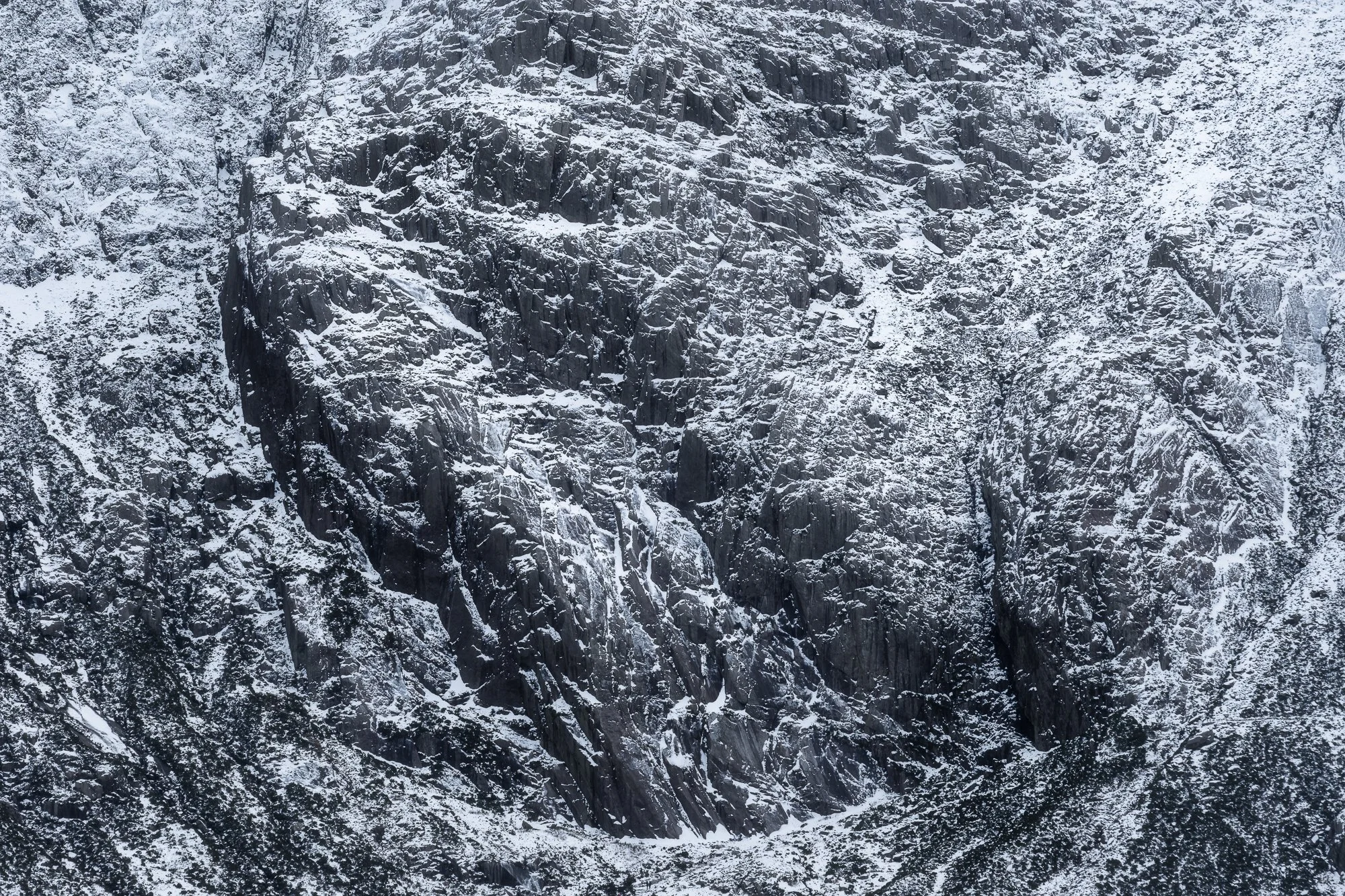
Fujifilm XT5 | XF50-140mm F2.8 | 91mm | 1/30th Second | f/11 | ISO125

Fujifilm XT5 | XF50-140mm F2.8 | 115mm | 1/30th Second | f/11 | ISO125
Over the previous 24 hours, I hadn’t used my 50-140mm lens too much and I could see over in the distance how the snow-filled crevices against the darker rockface were creating all sorts of interesting textures and by zooming in on the mountains on the other side of the lake, I was able to fill the frame, creating the above abstract pictures of the mountain range. If you scroll back to the panoramic image above and look closely, you can see what part of the mountain these two are from.
Still using the telephoto lens, I decided to pick out a few more features in the landscape like this here of Llyn Ogwen and the mountain top further down. I just love the soft, cool tones in the closeup photo of Llyn Ogwen below, particularly that vivid blue water. The two different tones across the surface of the lake are created by the partially frozen water. A very cool effect but signs that the temperature was rising.

Fujifilm XT5 | XF50-140mm F2.8 | 50mm | 1/40th Second | f/11 | ISO125
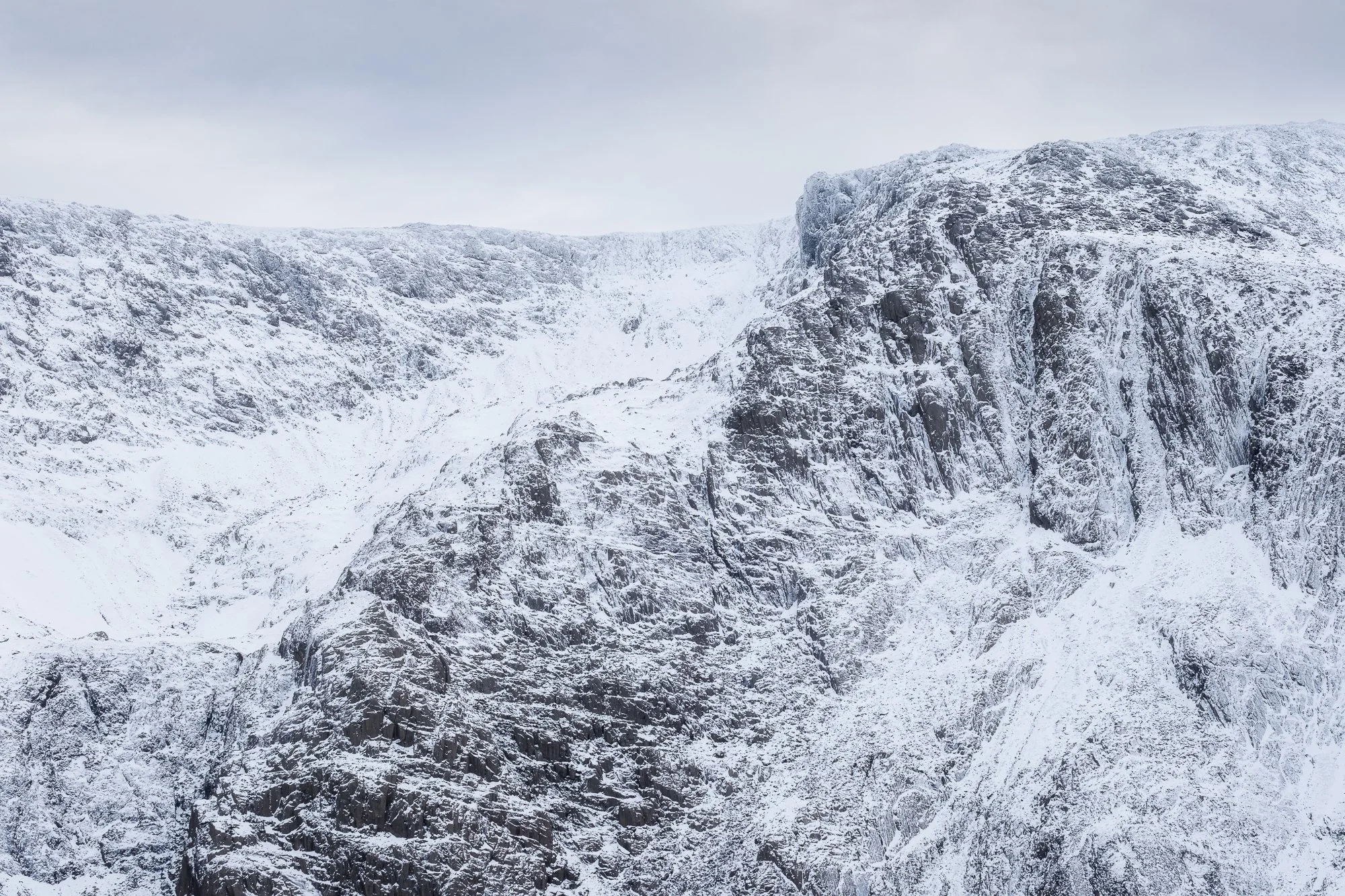
Fujifilm XT5 | XF50-140mm F2.8 | 56mm | 1/50th Second | f/11 | ISO125
With the wind increasing fast, I decided to throw the drone up one last time before it became too windy to fly. I few around capturing different compositions and the below images are two of my favourites. No panoramic images this time but I did manage to capture some different compositions of the two lakes.

DJI Mavic Mini 3 | 24mm (effective) | 1/1,600th Second | f/1.7 | ISO100

DJI Mavic Mini 3 | 24mm (effective) | 1/1,600th Second | f/1.7 | ISO100
Just before the light dipped too much, I took my final panoramic picture of this epic Snowdonia vista. Although it’s a similar composition to my first pano from this spot, I decided to go even wider and included all of Pen yr Ole Wen on the left-hand side. I think this addition adds more weight to the left-hand side and emphasises the distant view down, through the valley.
By this time, it was getting very cold out there and with the light levels dropping the resulting cooler tones work well to portray the freezing temperatures I was experiencing up on the side of the mountain. Just looking at this picture makes my toes feel cold again!! The resulting panoramic is made from 11 vertical pictures and even after some cropping, the resulting image is nearly 200 megapixels. I plan to print this image nice and big and can’t wait to see all that glorious detail!

Fujifilm XT5 | XF16-55mm F2.8 | 23mm | 0.4 Seconds | f/8 | ISO125
Photographing the Nant Gwynant Valley
Originally heading out at sunrise on my final morning to photograph Llyn Gwynant, I arrived in the dark and with my head torch on to guide the way, I climbed up the south-eastern side of the valley to get to a higher, less visited vantage point, offering a fantastic view down the valley towards the lake. Well, today, the views of Llyn Gwynant were far from fantastic. The air was hazy with light rain and there was very little clarity or contrast in the scene so as much as I tried, there was no image to take pointing down the valley.
I did, however, point my camera across the valley towards Gallt y Wenallt. Although at 619m it would be considered small compared to some of the 900-1000m peaks, from where I stood, the contrast provided by the snow on top gave it all the drama I needed to attach my telephoto lens and take the picture below.

Fujifilm XT5 | XF50-140mm F2.8 | 50mm | 1/125th Second | f/3.6 | ISO400
From where I stood, I had a pretty good view of Snowdon so, before heading back to the Ogwen Valley for the last time of the trip, I pointed my lens over at its partially obscured peaks and took the photo below. With the light so bad that morning, I’m pretty pleased to have come away with a couple of images I like.

Fujifilm XT5 | XF50-140mm F2.8 | 80mm | 1/200th Second | f/3.6 | ISO400
After climbing down and driving back in the Ogwen Valley, I did climb up to get another view of Tryfan once more but with the melting snow creating a very messy foreground, I decided against climbing all the way up and instead, used the 50-140mm telephoto lens once more to take a few closeup pictures of Tryfan’s peak and (I think) Glyder Fawr off to the right. It was the stark contrast and textures created by the dark, menacing rock and the bright, partially melted snow that I like about the photos I took. With poor shooting conditions, getting in close and seeking out alternative ways to photograph these epic landscapes was a great way to avoid coming away from this morning’s shoot empty-handed.

Fujifilm XT5 | XF50-140mm F2.8 | 54mm | 1/200th Second | f/9 | ISO200

Fujifilm XT5 | XF50-140mm F2.8 | 140mm | 1/100th Second | f/9 | ISO200
Photographing Llyn Idwal and the Devil’s kitchen
My very last stop before heading home was back up at Llyn Idwal. I had passed the waterfall at the foot of the trail a few times during the trip, each time hoping to stop and get a good photo of this view looking up at the falls with Y Garn’s peak in the background. Frustratingly, each previous time, the conditions weren’t right for the picture I wanted to take. Either the sky was bright blue with too much contrast or, the sun was directly in line with the view meaning the sky was too bright for my taste.
Thankfully, as I crossed the bridge on this very last visit, the shot was on! The low, dark clouds kissing the peaks in the background added the right amount of drama and the dark rocks flanking the falls helped to emphasise the water making its way down the hill.
With the tripod up and the 16-55mm lens attached, I opted for a longer exposure to smooth out the water as it cascaded down, between the rocks. With the ND filter on the lens and with everything in the frame lined up, I took what ended up being one of my favourite shots of the trip.

Fujifilm XT5 | XF16-55mm F2.8 | 18mm | 1/5th Second | f/10 | ISO200
Happy I had the waterfall shot I was after and having arrived up at Llyn Idwal, I wanted to take a picture of this classic view of The Devil’s Kitchen. The wind was getting up by now and it was creating ripples across the lake’s surface, giving it a messy, cluttered look, so before taking the shot, I mounted my ND filter (6-stop I think) to smooth out those ripples and help simplify the composition.
I just love the texture in those foreground rocks, for me they are the main subject of the composition, so I got the camera as low down as I could to make the most of them. Along with the ND filter I was using, I also attached my circular polariser which worked a treat to remove any glare from the rocks and eliminate any reflections in the water and bringing out some of the details from underneath the surface closer to the camera.
In an ideal world, I would have liked just a bit more sky but if I lifted the camera, I would have lost some of the foreground elements, so this would be the second time in the trip that the 16-55mm lens was a little tight. Next time I visit, a wider lens will be in my bag for sure.

Fujifilm XT5 | XF16-55mm F2.8 | 16mm | 13 Seconds | f/8 | ISO200

Fujifilm XT5 | XF16-55mm F2.8 | 22mm | 10 Seconds | f/8 | ISO200
With a long drive home ahead of me and with the rain now falling hard, it was time to call it a day and head to the car.
As a photographer, when you visit an area for the first time and don’t get the opportunity to return often, luck plays a huge part in whether you walk away with any keepers and it would be unrealistic to expect to come away from every location with a banging shot, so I am incredibly grateful for those I did manage to get on this trip and with some lessons learned and experience gained, I feel a little more prepared for my inevitable return with the camera.
Thanks for sticking with this incredibly long post1
Until next time,
Trevor.

On Location | Photographing Waterfalls in the Brecon Beacons
In April 2022, I visited the Brecon Beacons to spend a couple of days exploring and photographing some of the wonderful waterfalls this beautiful national park has to offer.
In April 2022, I visited the Brecon Beacons to spend a couple of days exploring some of the various waterfalls this beautiful national park has to offer. This was my second visit to the waterfalls, the first being October 2021 when they were surrounded by autumnal colours. During that previous visit, I managed to take a couple of photos I really liked but at the same time, I couldn’t help wonder what it would be like to photograph the falls surrounded by the fresh green leaves of spring. So, thinking that April would be the best time to ensure the trees had new leaves and the greens would still be lush and vibrant, I booked a hotel for a couple of nights and with a full tank of eye-wateringly expensive fuel and my camera bag packed, I headed out to the Brecon Beacons National Park once again.
Just a couple of housekeeping notes on the photos below. I decided not to post them chronologically, but to group the photos I took across both days based on the falls they were taken at. So, although you might see some similar compositions, you should see a difference in time of day, light and weather to see how the falls look in the different conditions.
Additionally, it will be obvious to some that there is a 4th waterfall, Sgwd Clun-Gwyn missing from this post. The truth is I just couldn’t find a workable composition during my visit. I’m not sure if it was the lack of flow from the river, the light at the time or my ability in finding a good composition (probably all three), so, I came away with no photos of this particular fall.
What was in my camera bag for this trip?
Talking about having my bag packed, here’s a quick overview of the gear I took to photograph the waterfalls in the Brecon Beacons. Along with the usual camera and tripod, I had with me the three lenses I take on all landscape photography trips, the wide 10-24mm, the standard 18-55mm zoom and telephoto 55-200mm. The XT2 camera is an APS-C sensor so feel free to convert the lenses to the 35mm equivalent.
Along with the camera, lenses and usual accessories, I had my set of Kase filters with me which I used consistently throughout the shoot to achieve two very important jobs. Firstly, the circular polarizing filter was used to reduce the reflected light and glare from bouncing off the water and wet rocks, control the highlights and boosting the colours. Secondly, I used the neutral density filters to reduce the light hitting the sensor, allowing me to use longer shutter speeds, helping to smooth the water, giving it that silky look as it flows and falls.

Where is the best place to park when visiting the Brecon Beacon Waterfalls?
There are at least three car parks located near this stretch of the river. The larger, paid car parks are probably the most accessible, but it means a longer downhill walk (uphill all the way back) to get to the falls. If you are looking for a little less faff and are happy with a longer walk, see below for a link to two of the large car parks nearby. The falls are well signposted and easy to find. The cost for a day’s parking was £5 and both take card payments.
Four Waterfalls Car Park: https://goo.gl/maps/gmsWApCx3drg71BP8
Gwaun Hepste - Four Falls Trail Car Park: https://goo.gl/maps/R1xGWj8MV6dunLTC8
My preference, however, is to park at the Small Car Park which, as the name suggests is very small but a lot closer to the falls. It gets full quickly but if heading out particularly early then you should find a spot.
Small Car Park: https://goo.gl/maps/MUPhkEokn6CexoX7A
One last option is a private field which is open most days right next to the Small Car Park. As far as I know, they also charge £5 but I’ve not used this car park before, so if you do manage to park your car here, do check when the gate is locked, just in case.
Photographing Sgwd Isaf Clun-Gwyn Waterfall
As I mentioned above, I don’t have any photos to share of the Sgwd Clun-Gwyn Waterfall so working down the river, the first set of images were taken at Sgwd Isaf Clun-Gwyn Waterfall. In my opinion, this cascading set of falls is the most interesting and provides a host of different compositions to choose from.
Starting at the top, this spot is a bit of a scramble up the hill but once in position, you’re greeted with this sweeping line which forms the edge of the upper falls. Compared to my visit in 2021 when the levels were higher and flow a lot stronger, this time around, it was very different. With less water flowing over the edge, the falls had less impact and the photos were less about demonstrating the power the falls can possess but more about the subtle beauty of the silky water, delicately cascading through the rugged Welsh landscape.

Fujifilm XT2 | XF18-55mm | 18mm | 1/4th Second | f/4.5 | ISO200

Fujifilm XT2 | XF55-200mm | 61mm | 1/3rd Second | f/10 | ISO200

Fujifilm XT2 | XF55-200mm | 95mm | 0.8 Seconds | f/8 | ISO200
Along with the wide photos of the falls, I also made sure to use my 55-200mm telephoto zoom lens to take some close-up, intimate landscapes. I wanted to capture the shapes and textures of the rocks and water, because together with the wide-angle photos, they all help to document the trip, telling a more complete story of my time there.
Now standing towards the bottom of Sgwd Isaf Clun-Gwyn, you get a better view back up the falls and of the various levels the water has to work its way down, temporarily spending time in this small pool, before getting on its way again down towards Sgwd y Pannwr.

Fujifilm XT2 | XF18-55mm | 19mm | 1/15th Second | f/9 | ISO200

Fujifilm XT2 | XF18-55mm | 50mm | 1/4th Second | f/11 | ISO200

Fujifilm XT2 | XF55-200mm | 100mm | 1/5th Second | f/8 | ISO200
For the photo below (and the almost identical version taken the previous day above), I wanted to get the entire scene into the frame, but I couldn’t get the results I wanted with the 10-24mm lens. The wide focal length was pushing the background further away, including too much sky, so I decided to forgo the wide-angle and take a multi-frame panoramic image with the standard zoom instead. Sweeping from left to right with my 18-55mm lens attached, I took 3 photos which were then merged together later in Adobe Lightroom.
Of the two panoramic photos I took of this scene, I much prefer this one below. The slight mist in the air helped to defuse the sunlight and by using the CPL filter when photographing the wet rocks, it helped remove most of the glare and distractions from around the edge of the frame.

Fujifilm XT2 | XF18-55mm | 18mm | 1 Second | f/8 | ISO200

Fujifilm XT2 | XF18-55mm | 34mm | 1/10th Second | f/8 | ISO200

Fujifilm XT2 | XF55-200mm | 82mm | 1/3rd Second | f/8 | ISO200
The final photo from Sgwd Isaf Clun-Gwyn waterfall below was taken back near the top but this time on the other side of the river. It’s a photo I wasn’t able to take on my previous visit as I ran out of time looking for the route to the spot, but with the water level a lot lower this time, I was able to make my way across the river just a little up-stream and get to this location far easier.
As you can see, from this vantage point, you get a fantastic view of the entire top half of the waterfall as it flows down, cascading towards the pool at the bottom. Getting nice and wide with the 10-24mm lens, I placed the falls to the right and using the trees on the left to balance the composition. I think this is my favourite photo I took during my trip to the falls.

Fujifilm XT2 | XF10-24mm | 13mm | 0.8 Seconds | f/10 | ISO200
Photographing Sgwd y Pannwr Waterfall
Just a little further down the river is where you’ll find Sgwd y Pannwr waterfall. A bit more unconventional as the main drop is at a 90-degree angle to the direction the river is flowing, so it makes for an interesting time finding a good composition here.
Although I think the water in the photo below could do with a bit more flow, I do prefer it to when I was at the same spot in 2021. Back then, with the water gushing over the edge, the scene was a lot messier and it was much harder for me to get a good photo from this angle. This time around, I was able to scramble around the edge of the pool and take the photo below.

Fujifilm XT2 | XF18-55mm | 25mm | 1/3rd Second | f/7.1 | ISO200

Fujifilm XT2 | XF18-55mm | 34mm | 2 Seconds | f/8 | ISO200

Fujifilm XT2 | XF55-200mm | 74mm | 2 Seconds | f/11 | ISO200
On the upper level, the water has carved itself through the rock and although there was very little water up there, I still liked the way it created a useful lead-in line towards the interesting tree at the edge of the falls.
After taking that photo, I then climbed down into the gap and made my way out to the end so I could take a close-up photo of the water as it fell. I crept as close to the edge as I dared, mounted the 18-55mm and took this photo below which turned out to be my favourite from this particular waterfall.

Fujifilm XT2 | XF18-55mm | 18mm | 0.6 Seconds | f/9 | ISO200
Photographing Sgwd Yr Eira Waterfall
Probably the most famous and for sure, the most popular waterfall along this trail is Sgwd Yr Eira. Located at the southernmost point of the four falls trail, it’s well worth the extra walk and steep climb down as you are greeted with this stunning view at the bottom of the gorge. Being so popular, I can’t recommend enough to fellow landscape photographers to get here as early as possible to avoid the crowds of people who start arriving around mid-morning.

Fujifilm XT2 | XF18-55mm | 22mm | 1/3rd Second | f/9 | ISO200

Fujifilm XT2 | XF10-24mm | 10mm | 2 Seconds | f/8 | ISO200

Fujifilm XT2 | XF55-200mm | 61mm | 0.8 Seconds | f/9 | ISO200
What makes this waterfall a bit more special and the reason it’s the most popular spot along the trail is that you can walk right behind the falling water. Getting up close and personal and effectively inside the waterfall is a unique experience and one I just had to try and photograph. Although there is plenty of room to walk behind the water, finding a good composition turned out to be quite difficult because when standing directly behind the falls, you can’t get back far enough to fit it all in. To work around this space issue, I decided to walk to one side, mount the wide-angle lens and take the photo above, which not only allowed me to get more of the waterfall in the frame but also allowed me to include some of the textures and colour in the wet rocks behind it.
With the water levels being low (have I already mentioned that?), I was able to wade into the river and find some new compositions of Sgwd Yr Eira which is how I managed to take the photo below. Using my 10-24mm lens once again, I placed the camera just a few inches above the water to emphasise the rocks in the foreground. With the left-hand fall being a little lower than the other two, it does look a little unbalanced but there was nothing I could do about that and overall, I’m pretty happy with how this one turned out.

Fujifilm XT2 | XF10-24mm | 10mm | 0.5 Seconds | f/9 | ISO200
Photographing Sychryd Waterfall
During the late afternoon on my first day at the falls, I drove a few minutes south of the four waterfalls trail as I wanted to pay a visit to Sychryd waterfall. Located on a small section of the river Sychryd and close to a village called Pontneddfechan I found the nearest car park was at Dinas Rock which you can find here: https://goo.gl/maps/mntGhXc1YDeDAgW76 and is free to park at. After a short 5-10 minute walk up and around Dinas Rock, you drop down into the Sychryd Gorge which is where you will find this charming multi-tier waterfall.
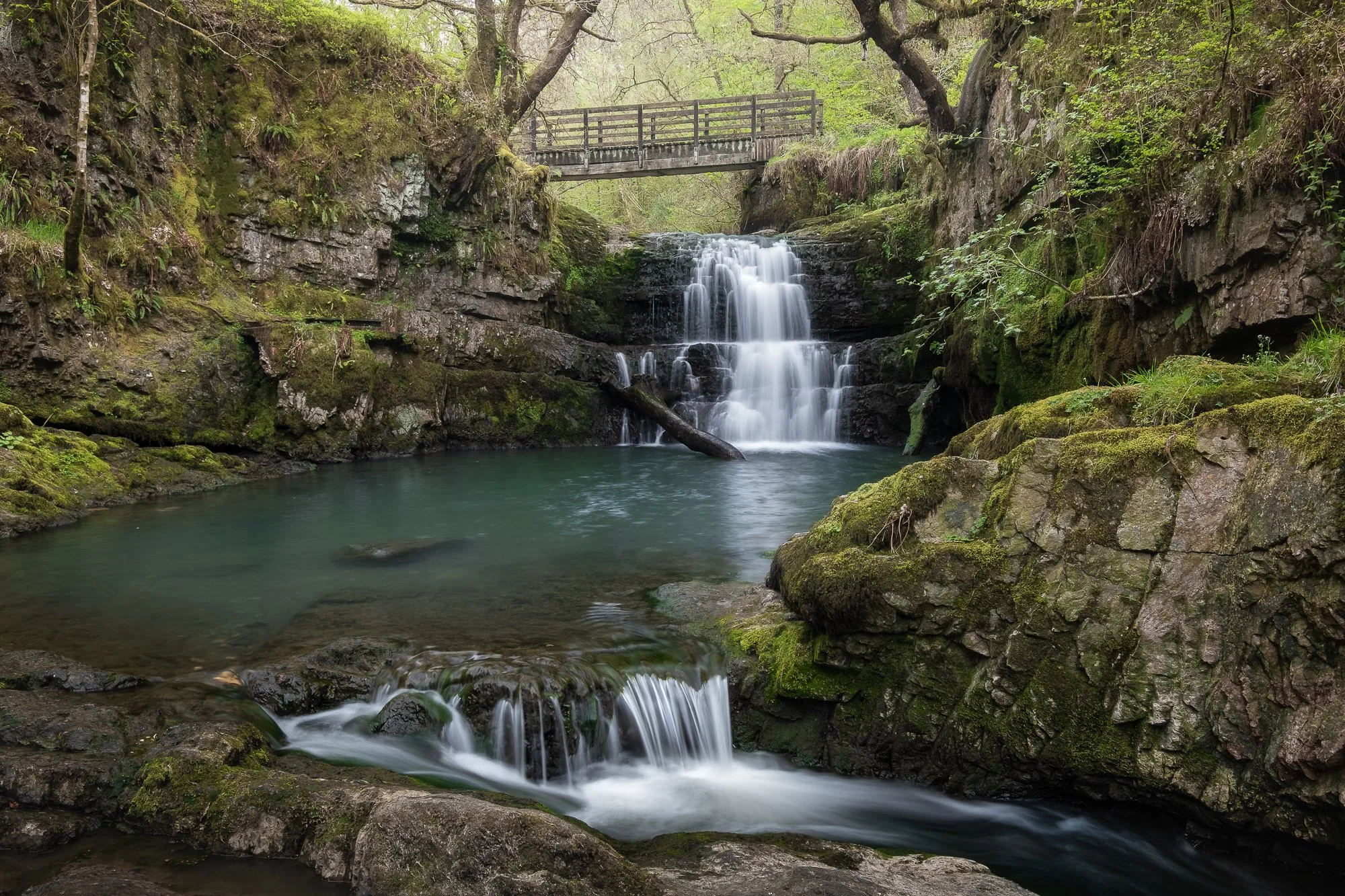
Fujifilm XT2 | XF10-24mm | 17mm | 1 Second | f/8 | ISO200

Fujifilm XT2 | XF55-200mm | 58mm | 1/4th Second | f/6.4 | ISO200

Fujifilm XT2 | XF55-200mm | 190mm | 1/5th Second | f/6.4 | ISO200
The first photo above and probably my favourite is the wider composition of the water cascading down into this emerald plunge pool named Pwll y Berw. Being careful not to include any bright, distracting sky above the trees, I purposely lowered my tripod so that the small cascade was included which added some useful depth and foreground interest to the photo.
With the light levels still quite bright, I took all of the photos here using two Kase filters stacked on top of each other. Firstly, the circular polarising filter which helped to cut any unwanted glare from the wet, reflective surfaces and secondly, a neutral density filter (I forget what strength) to elongate the shutter speed, helping to create that silky smooth effect with the waterfall.
Once done taking the wider photos, I attached my telephoto 55-200mm lens and zoomed right in to take some close-up photos of the silky white, cascading water against the dark, wet rocks underneath.
Dinas Rock (Welsh for Fortress Rock) is a large limestone cliff face and a popular place for experienced rock climbers. On my way back to the carpark, I noticed these green trees growing out of the middle of it and was drawn to the way the green leaves contrasted against the grey stone. So, I mounted my 55-200mm lens once more and snapped a photo.

Fujifilm XT2 | XF55-200mm | 55mm | 1/4th Second | f/7.1 | ISO200

Fujifilm XT2 | XF55-200mm | 105mm | 1/20th Second | f/9 | ISO200
Photographing the local Woodland
Given how much I enjoy photographing the local woodland close to where I live, there was very little chance I would leave this place without photographing some of the interesting woodland scenes which flanked the river and waterfalls.

Fujifilm XT2 | XF18-55mm | 29mm | 4 Seconds | f/11 | ISO200

Fujifilm XT2 | XF55-200mm | 105mm | 1/60th Second | f/8 | ISO200

Fujifilm XT2 | XF10-24mm | 14mm | 1/15th Second | f/7.1 | ISO200

Fujifilm XT2 | XF18-55mm | 29mm | 1/15th Second | f/7.1 | ISO200
At the beginning of this post, I mentioned that I chose to visit again in April as I wanted to see and photograph the location while surrounded by the vibrant colours of spring but in truth, I feel I was still a couple of weeks early because although some of the trees such as those above were adorned with green leaves, others such as those below were only just waking up from their wintry sleep.
Given the lack of spring colour in the canopy and the unfavourable light I had, I still really like these photos as the twisted, almost gnarled shapes and overall arrangement of the trees still appeals to me.

Fujifilm XT2 | XF18-55mm | 33mm | 1/4th Second | f/8 | ISO200

Fujifilm XT2 | XF55-200mm | 58mm | 0.4 Seconds | f/8 | ISO200
So, that was my second visit to these amazing falls and I’m starting to think I might make this trip once every two years or so as I really enjoyed the previous two trips and there are still plenty more trails to explore here.
I hope you enjoyed this on location blog post and although I’m clearly no expert, if you do have any questions about an upcoming visit, feel free to message me directly or leave a comment below and I’ll try to help as much as I can.
Until next time,
Trevor

Chaotic Colour | Weekly Photo #129
An autumnal woodland scene in the Brecon Beacons
As promised last week, here’s an autumnal photo I took just a couple of weeks ago during a short trip to the Brecon Beacons in Wales. As mentioned in that previous post, I went to photograph the popular waterfalls along the Four Falls Trail but the Afon Mellte (River Mellte) and Afon Hepste (River Hepste) carve their way through some fantastic ancient woodland with an array of interesting trees so, despite some pretty miserable weather and flat light, I could not resist pointing my lens towards the trees and photograph some of the wonderful woodland they have there.
Before we get stuck in, I have some news. I’ve opened an online print store over on Etsy.com. I’ve been toying with the idea for a while, deciding where to host it and how to price the images and finally got around to setting it all up a few weeks ago. My plan is to offer all of the photos I post on my Weekly Photo series as prints but it’s going to take some time to get all 129of them up there, so if you see a photo anywhere on my website and you want to own your own print, drop me a message and I’ll get it added to the store in no time at all.
Here’s a link to the store https://www.etsy.com/uk/shop/TrevorSherwinPhoto, alternatively you can always find it in the menu at the top of this page.

I’m not going to lie, I found this an incredibly difficult scene to photograph and even now as I sit here writing this post, I’m pretty sure it’s tumultuous nature won’t appeal to everyone but all being well, by the time you get to the end of this blog, you will know why, at the very least, it appeals to me.
The main path that takes you from the car park, along the Four Falls Trail remains on the higher ground meaning for each of the four waterfalls, you need to take a separate path that descends down towards the water in the valley. I came across this scene as I was heading down the steep path towards the Sgwd y Pannwr waterfall which, between descents takes you through this small area of captivating woodland. I was mesmerized by how it looked and even though I knew that trying to find an orderly composition in a somewhat chaotic scene would challenge my relatively modest woodland photography skills, I just had to give it a go. So, after finishing up taking photos by the river, I headed back up to this spot to see what I could make of it.

Fujifilm XT2 | XF18-55mm | 32mm | 1/3rd Second | f/10 | ISO200
So, what drew me to this scene? First off, it’s a very different type of woodland to those I typically come across in good-old leafy Surrey. With the rocks and moss across the uneven floor, the quirky shapes carved by the trees and the plethora of autumnal tones, it just felt a little bit special. I probably spent a good 20 minutes or more working out how best to take this photo and eventually settled on this composition you see here. Along with the interesting shapes and textures, the order amongst the disorder is the way the rocks on the ground create a natural path leading the eye in towards an area flanked by the “V” shaped trees and splashes of vibrant yellow tones on either side.
As I mentioned at the start of this post, the weather throughout my trip was pretty miserable and in between the rain, the light was flat and uninspiring. In an ideal world, I would have had some nice, defused light to bring out more of the vibrant colours in this woodland scene, but it wasn’t to be and I had to make the best of the conditions I was given both on location and back home in Lightroom when processing the final image. I had to be careful with the colours, making sure I didn’t overcook them. Some might be tempted to boost the yellows too much and force them to be what they might have been with better light. I chose to make more subtle changes, so the final photo represents the conditions I experienced on that very day.
Once again, please feel free to pop by my new online print store and have a good look around. I’d love to hear what you think so feel free to get in touch.
Until next week.
Trevor
This post is featured in my Weekly Photo series where I post a new photo every Monday. To have this delivered directly to your inbox, you can subscribe to the mailing list here.
A three-day autumn journey through Snowdonia, capturing intimate woodland scenes, grand vistas, and fresh perspectives on this iconic landscape.