
Apollo Remastered by Andy Saunders | My Photo Bookshelf
Although this Photo Bookshelf series typically features books connected in some way to landscape photography, every now and then I like to include something a little different, while still remaining closely tied to photography itself. Apollo Remastered is another example of that.
I’ve long had a fascination with space exploration and have spent countless hours watching documentaries about the Apollo missions and the early years of human spaceflight. So when I discovered a book featuring remastered photography from the Mercury, Gemini, and Apollo programmes, it immediately felt like something I needed to add to my bookshelf.
Author’s synopsis
The definitive book about the Apollo missions: extraordinary, newly restored images from the NASA archives.
In a frozen vault in Houston sits the original NASA photographic film of the Apollo missions. For half a century, almost every image of the Moon landings publicly available was produced from a lower-quality copy of these frozen originals.
Over the last few years, image restorer Andy Saunders has been working hard. Taking newly available digital scans and applying painstaking care and cutting-edge enhancement techniques, he has created the highest quality Apollo photographs ever produced.
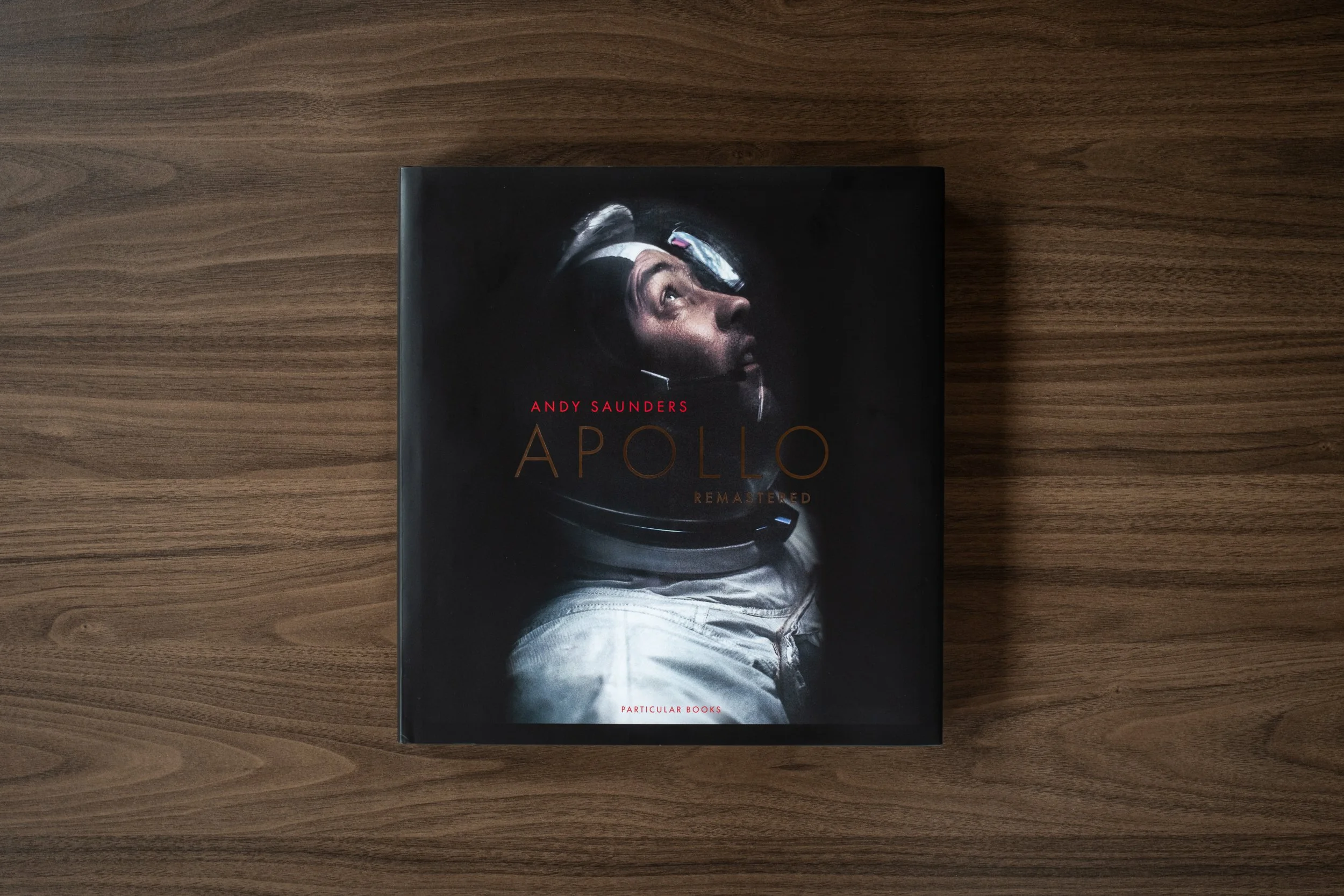
Never-before-seen spacewalks and crystal-clear portraits of astronauts in their spacecraft, along with startling new visions of the Earth and the Moon, offer astounding new insight into one of our greatest endeavours.
This is the definitive record of the Apollo missions and a mesmerising, high-definition journey into the unknown.
My thoughts about the book
Apollo Remastered is a book created by Andy Saunders and is a project that brings some of the most important photographs in human history back into focus, showing them in a way they were never really able to be seen before. Using original NASA film scans from the Mercury, Gemini and Apollo missions, Saunders painstakingly restored and remastered the imagery using modern digital techniques, revealing remarkable levels of detail, clarity, and colour that could almost be mistaken for images created on modern cameras.
It’s a large book, and with 456 pages, it is also quite heavy, but don’t let that put you off. The size and weight are, in my opinion, a deliberate choice to ensure as many images as possible are included and that they are printed large enough to showcase all of that newly revealed clarity and detail.
The book starts with a preface, introducing the project, followed by a chapter focusing on the journey from the Earth to the Moon. In this section, we are taken through the early stages of the missions, from launch through to the journey into space, setting the scene for what follows and providing context for the images that come later.
From there, there is a chapter that features photographs from the pre-Apollo missions, Mercury and Gemini. Including these sections helps provide additional context and builds a clearer sense of the progression that led up to the Apollo programme itself, showing how each stage of early space exploration contributed to what was ultimately achieved on the Moon.
Then we have a chapter for each of the Apollo missions, starting at Apollo 7 through to Apollo 17. Each of these chapters follows a consistent structure, beginning with technical mission details such as launch and landing dates, mission duration, and the amount of time the astronauts spent on the Moon’s surface.
This is followed by a section introducing the mission’s crew, along with an overview that helps frame the objectives and significance of each flight. Finally, before moving into the imagery itself, there are usually a few paragraphs outlining the photographic equipment used on the mission, which adds useful context for understanding how these images were originally captured in such extreme conditions.
The book then moves into the photographs, which form the heart of Apollo Remastered. Many of the most iconic images from the Apollo programme are included, such as the first human steps on the Moon, the Earthrise over the lunar horizon, astronauts working on the surface, and the now-familiar portraits of spacecraft and equipment suspended in orbit.
What is most striking is just how much new life these images seem to have. Even photographs that feel instantly recognisable take on a completely different presence here, with extraordinary levels of detail, texture, and tonal depth revealed through the restoration work. Shadows feel deeper, surfaces more tactile, and the sense of scale far more immediate than in any previous versions I have seen.
The sheer time and care taken to painstakingly restore each and every image cannot be underestimated. It is this dedication to detail that transforms the book from a historical archive into something that feels almost contemporary in its visual impact, allowing these moments to be experienced with a clarity that feels genuinely new.
After the Apollo mission chapters, the book concludes with a series of sections that explore the photographic aspects in more depth. These cover topics such as the development of space photography, the photographic objectives during the missions themselves, and the image processing and restoration work that has brought these photographs back to life.
If you’re interested in the technical side of photography and how these images were originally captured, transmitted, and later restored, this part of the book is particularly engaging. It adds an extra layer of understanding to the imagery and brings the whole experience to a fitting close.
Overall, this book is a showcase of beautifully restored photographs from some of the most significant space exploration missions in history, alongside a wealth of context and information that helps bring those moments to life. Despite the depth of material covered, everything is presented in a way that never feels overwhelming, with a clear and structured flow that makes it easy to follow and absorb. It strikes a careful balance between visual impact and accessible storytelling, allowing the reader to take in both the technical detail and the extraordinary imagery at their own pace.
If you have an interest in photography, history, and space exploration, this is a book that will not disappoint.
Book Details
Hardcover
Size: 29.8cm x 31.6cm x 3.6cm and weighing 3.3kg
Pages: 456
Availability at the time of writing: Still in print. Purchase options are available from the author’s website: https://www.apolloremastered.com/apollo-remastered and major online bookshops.
Until next time.
Trevor